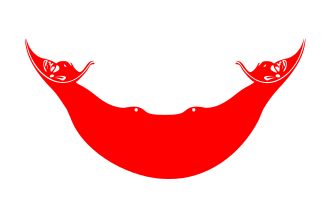
The flag consists of a white field bearing a large red reimiro at its center. At first glance, the design feels almost austere, but every element is deeply rooted in Rapa Nui identity.
The Reimiro Symbol
The reimiro is a traditional crescent-shaped pectoral ornament once worn by Rapa Nui chiefs and people of high status. Often carved from wood and sometimes inlaid with shells, it symbolized authority, lineage, and connection to the ancestors.
On the flag, the reimiro is rendered in bold red, a color associated across Polynesia with mana—spiritual power, vitality, and sacredness. The ends of the crescent often feature stylized faces, representing ancestral guardians watching over the island.
White Background
The white field is commonly interpreted as representing purity, peace, and the island itself—isolated in the vast Pacific, surrounded by ocean and sky. It also allows the reimiro to dominate visually, reinforcing that Rapa Nui culture sits at the center of the island’s identity.
Cultural and Political Meaning
Although Easter Island is administratively part of Chile, the Rapa Nui flag is a powerful expression of Indigenous identity and autonomy. It is frequently flown during cultural festivals, ceremonies, and protests related to land rights, self-determination, and cultural preservation.
In this sense, the flag functions less as a national emblem and more as a statement of continuity—linking present-day Rapa Nui people to their ancestors, their language, and their land.
A Flag of Survival
Unlike many flags designed by modern states, the Rapa Nui flag feels almost timeless. Its symbolism predates colonial borders and modern geopolitics. It speaks of a culture that survived extreme isolation, ecological collapse, missionary pressure, and political absorption—yet continues to assert itself visually, proudly, and unmistakably.
The flag of Easter Island is not about sovereignty on paper, but sovereignty of memory, culture, and place.