The flag of Iraq is more than a national symbol. It tells the story of a country that has witnessed the rise and fall of empires, the birth of civilizations, revolutions, wars, and political transformation. Every colour and symbol on the Iraqi flag reflects a chapter of the country’s history and its place within the Arab world.
Today, the Iraqi flag flies above a nation that is heir to the ancient civilizations of Mesopotamia, often referred to as the “Cradle of Civilization.” Yet the flag itself is relatively modern, evolving alongside Iraq’s political journey through the twentieth and twenty-first centuries.
The Current Flag of Iraq
The current Iraqi flag consists of three horizontal stripes:
- Red on the top
- White in the middle
- Black on the bottom
Centered on the white stripe is the phrase الله أكبر (Allahu Akbar), meaning “God is Great,” written in green Kufic Arabic script.
At first glance, the design appears simple. However, every element carries deep historical, cultural, and political significance.

The Meaning of the Colours
Iraq’s flag uses the traditional Pan-Arab colours, which are shared by many Arab nations and symbolize a common cultural and historical heritage.
Red
The red stripe represents courage, sacrifice, and the struggles endured throughout history. It honours those who fought for Iraq’s independence and sovereignty.
White
White symbolizes peace, hope, and a brighter future. It also reflects generosity and dignity, values deeply rooted in Arab culture.
Black
Black recalls both the hardships Iraq has endured and the legacy of historic Arab dynasties, particularly the Abbasid Caliphate, whose capital was Baghdad.
Green
The green inscription symbolizes Islam, the faith practiced by the majority of Iraq’s population. Green has long been associated with prosperity, renewal, and spiritual significance throughout the Islamic world.
The Origins of the Iraqi Flag
The roots of Iraq’s modern flag can be traced back to the early twentieth century following the collapse of the Ottoman Empire.
After gaining independence in 1932, Iraq used several different flag designs. These reflected changing governments, political ideologies, and regional ambitions.
The modern tricolour design emerged during a period when many Arab countries embraced Pan-Arabism, a movement that sought greater unity among Arab nations.
The colours linked Iraq to a wider Arab identity while still allowing the country to maintain its own national symbolism.
Iraq Under Saddam Hussein
No discussion of the Iraqi flag is complete without examining the period under Saddam Hussein.
Who Was Saddam Hussein?
Saddam Hussein ruled Iraq from 1979 until 2003. During his presidency, Iraq underwent rapid modernization in some areas, benefiting from oil wealth and major state-led development projects.
The Saddam-Era Flag
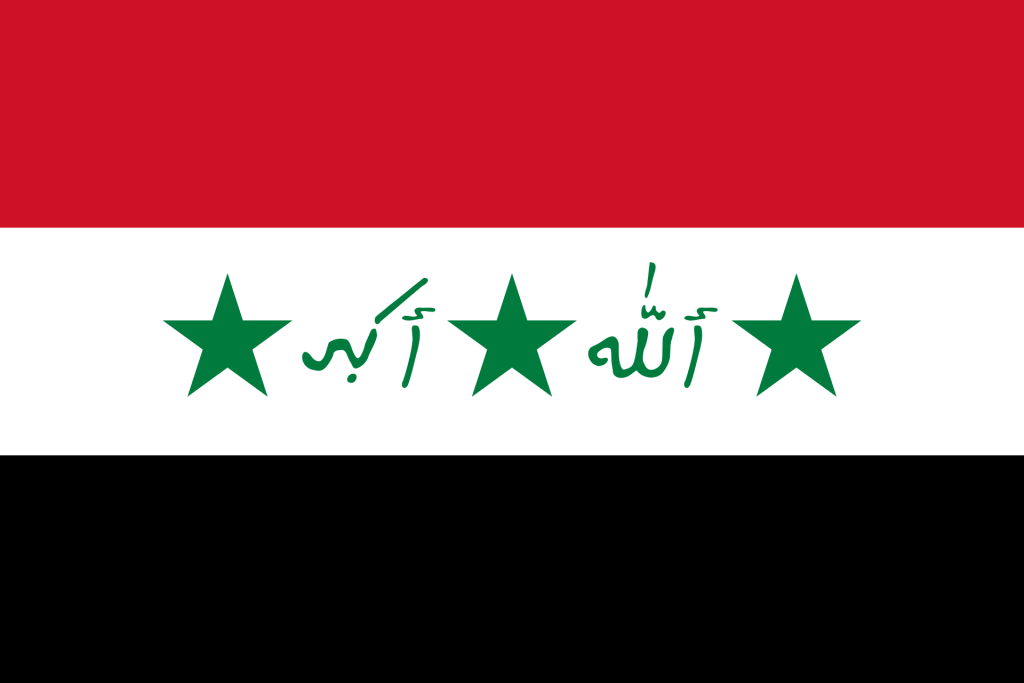
The version of the Iraqi flag most associated with Saddam Hussein featured three green stars on the white stripe.
Originally, these stars represented the hoped-for union of Iraq, Egypt, and Syria as part of the Pan-Arab movement.
Following the Gulf War in 1991, Saddam ordered the addition of the phrase “Allahu Akbar” between the stars.
According to Iraqi officials, the inscription was written in Saddam Hussein’s own handwriting. This made the flag highly personal to his regime and transformed it into one of the most recognizable symbols of Iraq during the 1990s and early 2000s.
For many Iraqis, the flag became inseparable from the political realities of that era.
The Fall of Saddam and a New Flag
Following the U.S.-led invasion of Iraq in 2003 and the collapse of Saddam Hussein’s government, the country entered a period of political transition.
Questions quickly emerged about national symbols, including the flag.
Many Iraqis wanted to retain continuity with the country’s history, while others sought to remove symbols linked to Saddam’s rule.
After several proposals and debates, Iraq adopted a revised version of the flag in 2008.
The changes included:
- Removing the three green stars
- Replacing Saddam’s handwritten script
- Retaining the phrase “Allahu Akbar”
- Introducing a traditional Kufic script
This compromise allowed Iraq to preserve an important cultural and religious element while distancing the national flag from the former regime.
The Flag Today
Today, the Iraqi flag represents all Iraqis regardless of ethnicity, religion, or region.
It flies above a country that is home to:
- Arabs
- Kurds
- Turkmen
- Assyrians
- Yazidis
- Christians
- Muslims and other communities
It serves as a symbol of national unity in a country that continues to rebuild and redefine itself after decades of conflict.
Iraq: More Than Headlines
For many people outside the region, Iraq is often associated with war and political instability. Yet the country possesses one of the richest cultural and historical legacies on Earth.
This is the land where some of humanity’s earliest cities emerged. Ancient Mesopotamia gave the world writing, laws, mathematics, and some of the first organized societies.
Visitors can explore extraordinary sites such as:
- Baghdad
- Babylon
- Hatra
- Samarra
- Najaf
- Karbala
- Mosul
- The Marshes of Southern Iraq
These places reveal a side of Iraq that is often overlooked in international media.
Conclusion
The flag of Iraq reflects the story of a nation that has experienced immense change throughout its history. From the ancient civilizations of Mesopotamia to the modern republic, the flag has evolved alongside the country itself.
Its colours symbolize Arab heritage, its inscription reflects cultural and religious traditions, and its history mirrors Iraq’s political transformations. More than a piece of cloth, it is a symbol of resilience, identity, and continuity.
QuixoticGuide Note
Iraq is one of my favourite countries in the world and one that continues to surprise me every time I visit. From the bustling streets of Baghdad to the spiritual centres of Najaf and Karbala, and from the ancient ruins of Babylon to the UNESCO-listed city of Hatra, Iraq offers experiences found nowhere else. Despite its challenging recent history, it remains one of the most rewarding and fascinating destinations in the Middle East.