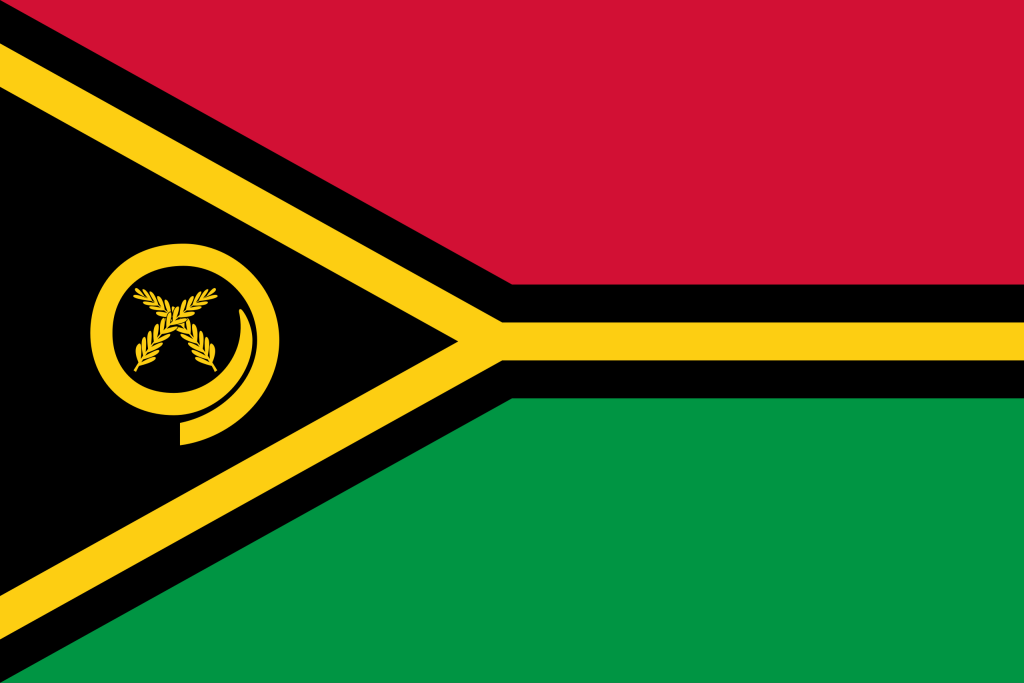
The flag of Vanuatu is one of the most distinctive national flags in the world. Adopted on 18 February 1980, just months before the country gained independence from the Anglo-French Condominium of the New Hebrides, it reflects the nation’s culture, geography, traditions, and aspirations.
History of the Flag of Vanuatu
Before independence, Vanuatu—then known as the New Hebrides—was jointly administered by the United Kingdom and France. As the independence movement gained momentum during the 1970s, the political party Vanua’aku Pati adopted a flag designed by local artist Kalontas Mahlon. Its colours later formed the basis of the national flag.
Following independence on 30 July 1980, a parliamentary committee refined the design while retaining its symbolic colours and cultural elements, creating the flag that remains in use today.
Meaning of the Flag of Vanuatu
Every colour and symbol on the flag carries a specific meaning:
- 🟢 Green represents the rich vegetation, fertile land, and agricultural heritage of the islands.
- 🔴 Red symbolises the blood shed in the struggle for independence, as well as the unity of the Ni-Vanuatu people.
- ⚫ Black represents the Melanesian people of Vanuatu.
- 🟡 Yellow symbolises the light of Christianity, which has played a significant role in the country’s history.
The striking Y-shaped yellow stripe represents the chain of more than 80 islands stretching across the Pacific Ocean.
Inside the black triangle are two traditional symbols:
- 🐗 Boar’s tusk – a symbol of prosperity, wealth, and status in traditional Ni-Vanuatu society.
- 🌿 Two crossed namele fern leaves – representing peace and the authority of local chiefs.
Interesting Facts
- 🇻🇺 The flag is one of the few national flags to feature traditional cultural symbols rather than stars, coats of arms, or geometric shapes alone.
- 🌊 The yellow Y-shape mirrors the geographical layout of Vanuatu’s island chain.
- 🗣️ Vanuatu is one of the world’s most linguistically diverse countries, with more than 100 indigenous languages spoken despite having a population of only around 330,000 people.
- 🎨 The original colour scheme was inspired by the flag of the Vanua’aku Pati, the political movement that led the country to independence.
Conclusion
The flag of Vanuatu is much more than a national emblem. It tells the story of a young island nation that values its cultural traditions, natural environment, Christian heritage, and hard-won independence. Its unique design makes it one of the most recognisable and meaningful flags in Oceania.