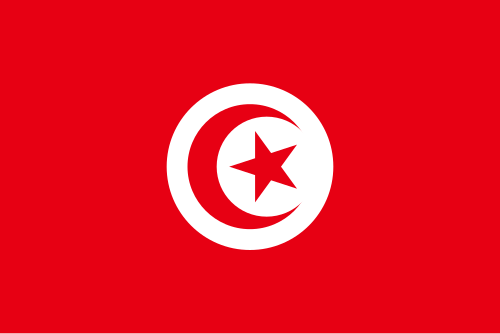
The flag of Tunisia is a bold and historic national symbol. Featuring a red field with a white circle containing a red crescent and five-pointed star, it reflects Tunisia’s history, identity, and cultural heritage. The design is closely linked to the country’s Ottoman past and its modern national identity.
History of the Flag of Tunisia
The origins of the Tunisian flag date back to the 19th century, during the rule of the Husainid dynasty. The design was inspired in part by the Ottoman flag, as Tunisia was historically connected to the Ottoman Empire.
The red flag with the crescent and star gradually became associated with Tunisia as a distinct political and national symbol. After Tunisia gained independence from France on 20 March 1956, the flag continued to be used as the national flag of the newly independent state.
The current form of the flag was officially confirmed after independence and later standardised by law to define its exact proportions and design.
Meaning of the Flag of Tunisia
Every element of the Tunisian flag carries symbolic meaning:
- 🔴 Red represents courage, sacrifice, and the blood of those who fought for the country.
- ⚪ White circle symbolises peace and purity.
- 🌙 Crescent is a traditional symbol associated with Islam and the wider Muslim world.
- ⭐ Five-pointed star is often linked to the Five Pillars of Islam and national unity.
The crescent and star together also reflect Tunisia’s historical connection to the Ottoman world, while the white circle makes the design distinct from the Turkish flag.
Interesting Facts
- 🇹🇳 Tunisia’s flag is one of the most recognisable flags in North Africa.
- 🌙 The crescent and star are symbols shared by several countries with historical or cultural links to the Islamic world.
- 🏛️ The flag’s design has remained remarkably consistent since the 19th century.
- 📜 Tunisia gained independence from France on 20 March 1956, and the flag became a central symbol of the new republic.
- 🌍 The red, white, crescent, and star design visually connects Tunisia to broader Mediterranean, Ottoman, and Islamic traditions.
Conclusion
The flag of Tunisia is simple, powerful, and deeply symbolic. Its red field, white circle, crescent, and star tell a story of history, faith, sacrifice, and independence. More than just a national emblem, it represents the identity and resilience of the Tunisian people.