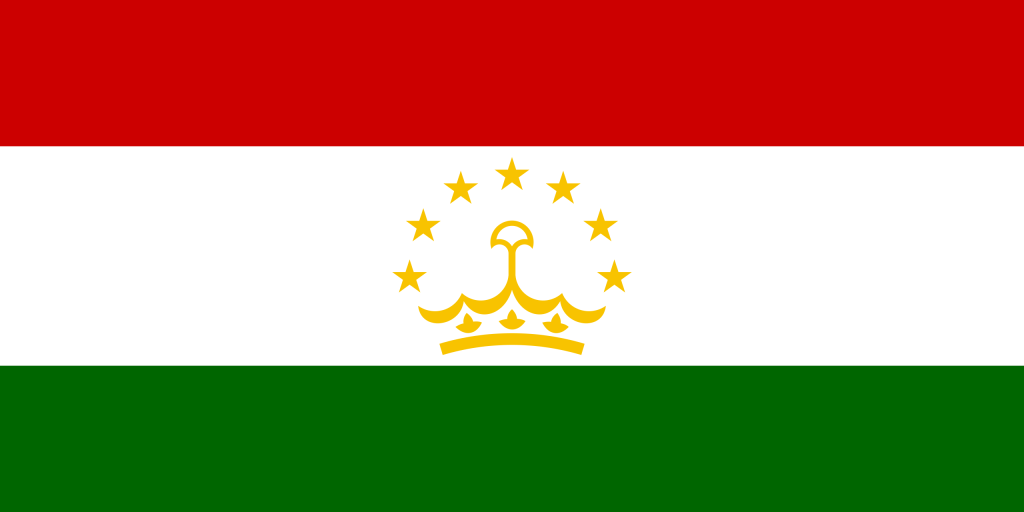
The flag of Tajikistan is a proud symbol of the country’s independence, cultural heritage, and national unity. Featuring three horizontal stripes of red, white, and green, with a golden crown and seven stars at its centre, it reflects Tajikistan’s history, prosperity, and aspirations. The flag was officially adopted on 24 November 1992, shortly after the country gained independence from the Soviet Union.
History of the Flag of Tajikistan
Following the collapse of the Soviet Union, Tajikistan declared its independence on 9 September 1991. The country soon sought new national symbols that reflected its own identity rather than its Soviet past.
On 24 November 1992, Tajikistan officially adopted its current national flag. While it retains the traditional Pan-Iranian colours of red, white, and green, the central crown and stars were added to represent the nation’s sovereignty and cultural heritage.
Since its adoption, the flag has become an important symbol of the independent Republic of Tajikistan.
Meaning of the Flag of Tajikistan
Each colour and symbol has a special meaning:
- 🔴 Red represents unity, courage, and the country’s struggle for freedom and independence.
- ⚪ White symbolises purity, peace, and the snow-covered mountains and cotton production that are vital to the country’s economy.
- 🟢 Green represents nature, agriculture, and prosperity.
At the centre of the flag are two important symbols:
- 👑 Golden crown represents the Tajik people and national sovereignty. The name “Tajik” is commonly associated with the Persian word for “crown”, although the exact etymology remains debated.
- ⭐ Seven golden stars symbolise perfection, happiness, and the culturally significant number seven, which has long held an important place in Persian and Tajik traditions.
Interesting Facts
- 🇹🇯 Tajikistan celebrates National Flag Day every year on 24 November.
- 🏔️ More than 90% of Tajikistan is covered by mountains, making it one of the most mountainous countries in the world.
- 🌍 The country is home to the Pamir Mountains, often referred to as the “Roof of the World.”
- 🚩 In 2011, Tajikistan raised what was then the world’s tallest flagpole, standing 165 metres (541 feet) tall in the capital, Dushanbe.
- ⭐ The number seven is deeply rooted in Tajik culture and Persian tradition, symbolising completeness, good fortune, and spiritual perfection.
Conclusion
The flag of Tajikistan is a meaningful representation of the nation’s independence, heritage, and future. Its vibrant colours, golden crown, and seven stars celebrate the country’s rich cultural traditions, mountainous landscape, and enduring national pride. Today, it stands as one of Central Asia’s most distinctive and symbolic national flags.