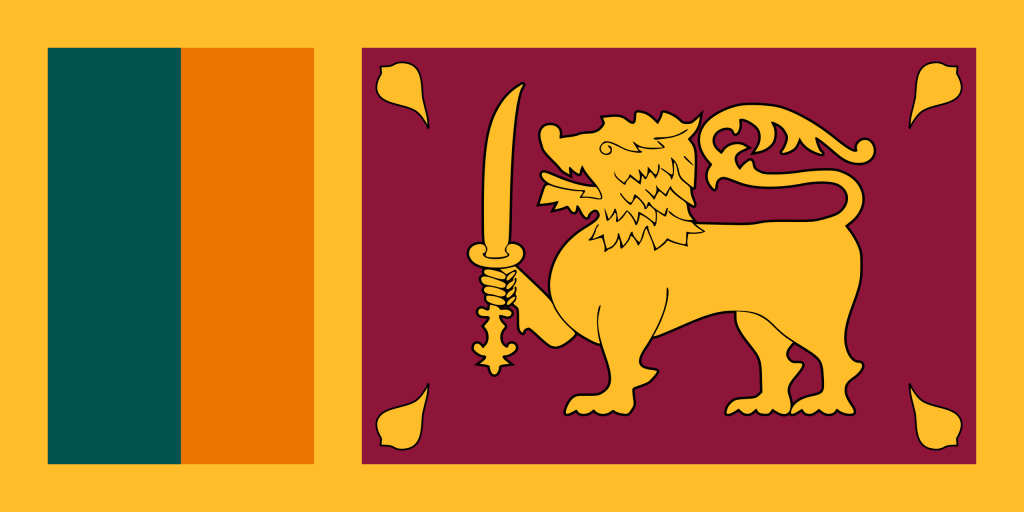
The flag of Sri Lanka, often referred to as the Lion Flag, is one of the world’s oldest and most distinctive national flags. Featuring a golden lion holding a sword on a maroon background, framed by a gold border, alongside green and orange vertical stripes, it reflects the country’s history, cultural diversity, and religious heritage. The current design was officially adopted on 22 May 1972.
History of the Flag of Sri Lanka
The origins of the Lion Flag date back centuries to the ancient Kingdom of Kandy, where the lion symbol represented the Sinhalese monarchy. Following British colonial rule, Sri Lanka—then known as Ceylon—gained independence on 4 February 1948, and the traditional Lion Flag was restored as the national flag.
In 1951, green and orange vertical stripes were added to represent the country’s Muslim and Tamil communities. When Ceylon became the Democratic Socialist Republic of Sri Lanka in 1972, the flag was slightly modified, including the addition of four golden Bo leaves in the corners of the maroon field. This is the design that remains in use today.
Meaning of the Flag of Sri Lanka
Every element of the flag has a symbolic meaning:
- 🦁 Golden lion represents bravery, strength, and the Sinhalese people.
- ⚔️ Sword symbolises sovereignty and the nation’s readiness to defend its freedom.
- 🟤 Maroon background represents the Sinhalese majority.
- 🟧 Orange stripe symbolises the Tamil community.
- 🟩 Green stripe represents the Muslim community.
- 🍃 Four Bo leaves represent loving-kindness, compassion, sympathetic joy, and equanimity—the four sublime virtues in Buddhism.
- 🟨 Golden border symbolises the unity of all Sri Lankans despite their diverse backgrounds.
Interesting Facts
- 🇱🇰 Sri Lanka’s flag is considered one of the oldest national flag designs still in use, with origins dating back many centuries.
- 🍃 The four Bo leaves come from the sacred Sri Maha Bodhi tree, under which the Buddha is believed to have attained enlightenment.
- 👑 The lion has been a symbol of the Sinhalese people for more than 2,000 years.
- 🎨 Sri Lanka’s flag is one of the few national flags to feature such a detailed central emblem.
- 🌍 The flag reflects the country’s multicultural society by incorporating symbols representing its major ethnic and religious communities.
Conclusion
The flag of Sri Lanka is a rich symbol of the country’s history, culture, and diversity. From the ancient Lion of the Sinhalese kingdoms to the Bo leaves representing Buddhist values and the stripes honouring different communities, every element tells part of Sri Lanka’s story. Today, it stands as a proud emblem of unity, heritage, and national identity.