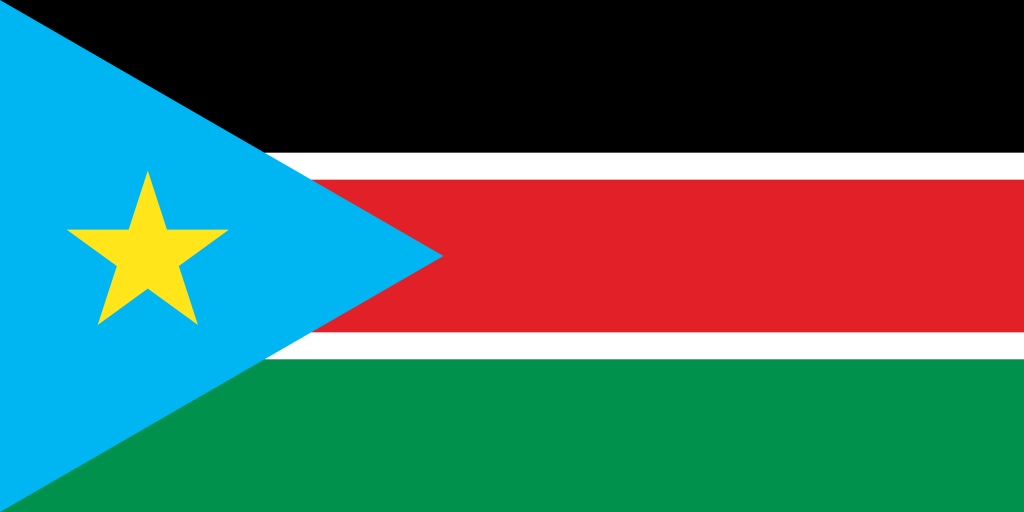
The flag of South Sudan is a powerful symbol of independence, hope, and national identity. Featuring horizontal stripes of black, red, and green, separated by thin white stripes, with a blue triangle and yellow star at the hoist, it reflects the country’s people, struggle, land, and future. The flag was officially adopted on 9 July 2011, the day South Sudan became independent from Sudan.
History of the Flag of South Sudan
South Sudan became the world’s newest country on 9 July 2011, following a referendum in which the majority of voters supported independence from Sudan.
The flag was originally used by the Sudan People’s Liberation Movement during the long struggle for self-determination. After independence, it was adopted as the national flag of the new Republic of South Sudan.
Its colours and symbols were chosen to represent both the sacrifices made during the independence struggle and the hopes of a new nation.
Meaning of the Flag of South Sudan
Every colour and symbol on the flag carries meaning:
- ⚫ Black represents the people of South Sudan.
- 🔴 Red symbolises the blood shed in the struggle for independence.
- 🟢 Green represents the country’s fertile land, agriculture, and natural wealth.
- ⚪ White stands for peace.
- 🔵 Blue triangle represents the waters of the Nile River.
- ⭐ Yellow star symbolises unity, hope, and the guiding light of the new nation.
Interesting Facts
- 🇸🇸 South Sudan adopted its flag on 9 July 2011, the same day it became independent.
- 🌍 South Sudan is the youngest internationally recognised country in the world.
- 🗳️ Independence followed a referendum held in January 2011.
- 🌊 The White Nile flows through South Sudan and is reflected in the flag’s blue triangle.
- ⭐ The yellow star is often called the Star of Bethlehem, symbolising unity and hope for the people.
Conclusion
The flag of South Sudan is a bold and meaningful symbol of a young nation. Its colours tell the story of sacrifice, peace, land, people, and hope, while the yellow star points toward unity and a better future. More than a national emblem, it represents the identity and aspirations of the South Sudanese people.