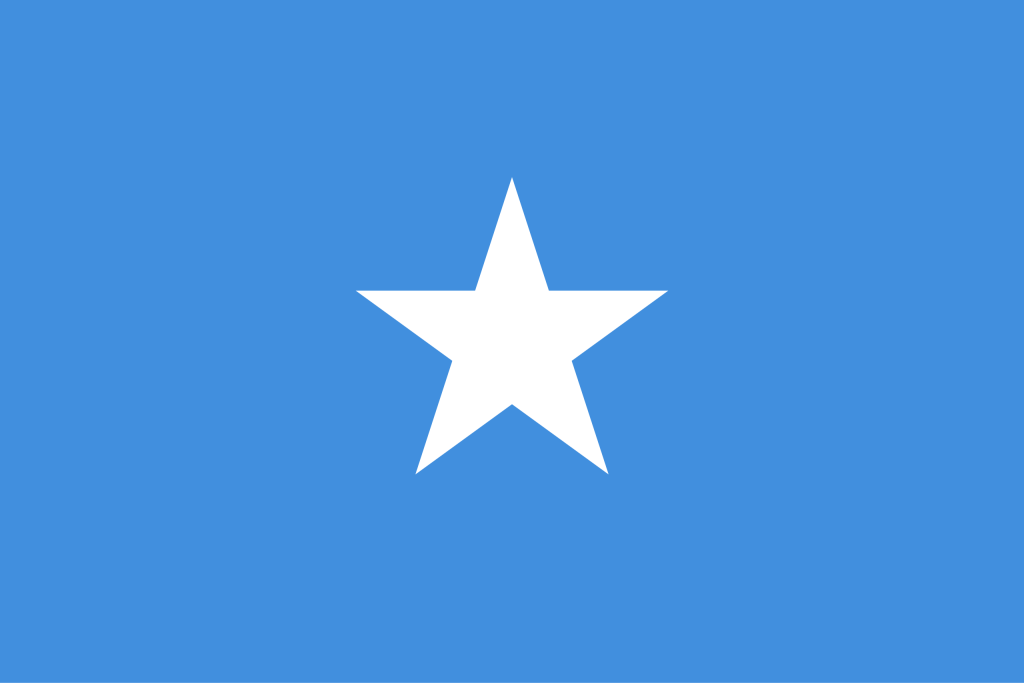
The flag of Somalia is a simple but powerful national symbol. Featuring a light blue field with a white five-pointed star at its centre, it represents unity, independence, and the Somali people. The flag was officially adopted on 12 October 1954.
History of the Flag of Somalia
The Somali flag was designed during the period of preparation for independence. At the time, parts of Somali territory were under different colonial administrations, including Italian and British rule.
The flag was adopted in 1954 for the Trust Territory of Somaliland under Italian administration and later became the national flag of the independent Somali Republic in 1960, when British Somaliland and Italian Somaliland united.
Its blue background was inspired by the flag of the United Nations, which had played a role in Somalia’s transition toward independence.
Meaning of the Flag of Somalia
Every element of the Somali flag has symbolic meaning:
- 🔵 Light blue represents the United Nations and the hope for peace.
- ⭐ White five-pointed star is known as the Star of Unity.
- ⚪ White symbolises peace and purity.
The five points of the star traditionally represent the five regions where Somali people have historically lived: Italian Somaliland, British Somaliland, French Somaliland, the Ogaden, and the Northern Frontier District.
Interesting Facts
- 🇸🇴 Somalia adopted its flag before full independence, in 1954.
- ⭐ The central star is commonly called the Star of Unity.
- 🌍 The flag became the national flag of the Somali Republic after independence and unification in 1960.
- 🔵 Its blue colour was inspired by the United Nations flag.
- 🐪 Somalia is located on the Horn of Africa and has one of the longest coastlines on the African mainland.
Conclusion
The flag of Somalia is elegant, meaningful, and instantly recognisable. Its blue field and white star reflect peace, unity, and the shared identity of the Somali people across the Horn of Africa. More than a national emblem, it remains a symbol of independence, hope, and Somali unity.