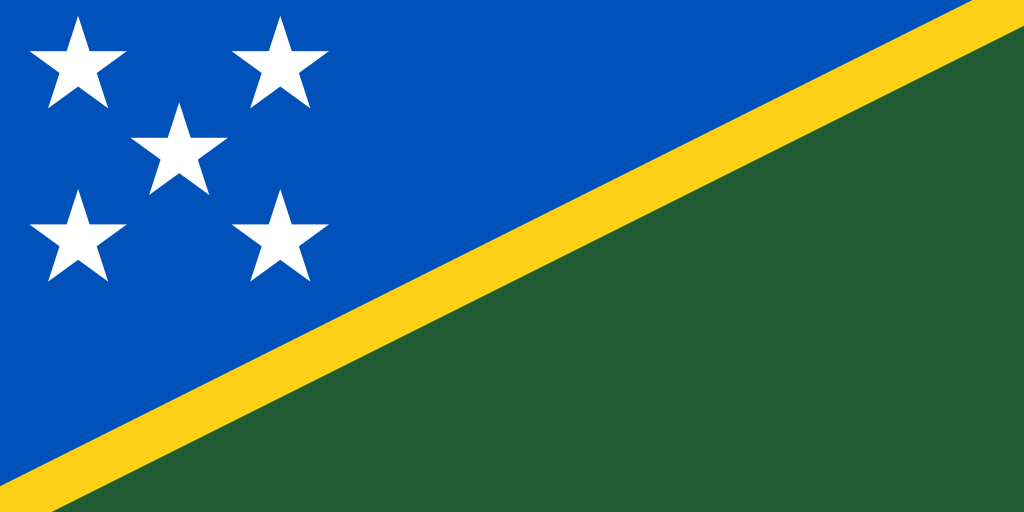
The flag of the Solomon Islands is a vibrant symbol of the nation’s natural beauty, unity, and maritime heritage. Featuring a blue upper triangle, a green lower triangle, separated by a yellow diagonal stripe, with five white stars in the upper hoist corner, it reflects the country’s islands, people, and rich environment. The flag was officially adopted on 18 November 1977, shortly before the Solomon Islands gained independence from the United Kingdom.
History of the Flag of Solomon Islands
As the Solomon Islands prepared for independence from the United Kingdom, a national flag competition was held to create a symbol that represented the country’s identity and future.
The winning design was officially adopted on 18 November 1977, several months before independence was achieved on 7 July 1978. Unlike many former British colonies, the Solomon Islands chose a completely original design rather than adapting a colonial Blue Ensign.
Since its adoption, the flag has remained unchanged and has become a proud symbol of the island nation.
Meaning of the Flag of Solomon Islands
Every colour and symbol on the flag has official significance:
- 🔵 Blue represents the Pacific Ocean and the many rivers and waterways of the islands.
- 🟢 Green symbolises the country’s fertile land, forests, and agriculture.
- 🟨 Yellow diagonal stripe represents sunshine and the connection between the islands.
- ⭐ Five white stars originally represented the country’s five administrative districts at the time the flag was adopted. Although the Solomon Islands now has more provinces, the stars continue to symbolise the unity of the nation.
Interesting Facts
- 🇸🇧 The Solomon Islands adopted their national flag on 18 November 1977, before gaining independence on 7 July 1978.
- 🌴 The country consists of nearly 1,000 islands scattered across the southwestern Pacific Ocean.
- ⭐ The five stars originally represented the nation’s five administrative districts in 1977.
- 🌊 The Solomon Islands are renowned for their coral reefs, tropical rainforests, and exceptional marine biodiversity.
- ⚔️ During the Second World War, the islands were the site of the famous Battle of Guadalcanal, one of the Pacific War’s most significant campaigns.
Conclusion
The flag of the Solomon Islands is a colourful symbol of the nation’s ocean, forests, sunshine, and unity. Its distinctive design reflects the country’s island geography and rich natural heritage while celebrating the shared identity of its people. Today, it proudly represents one of the Pacific’s most diverse and beautiful island nations.