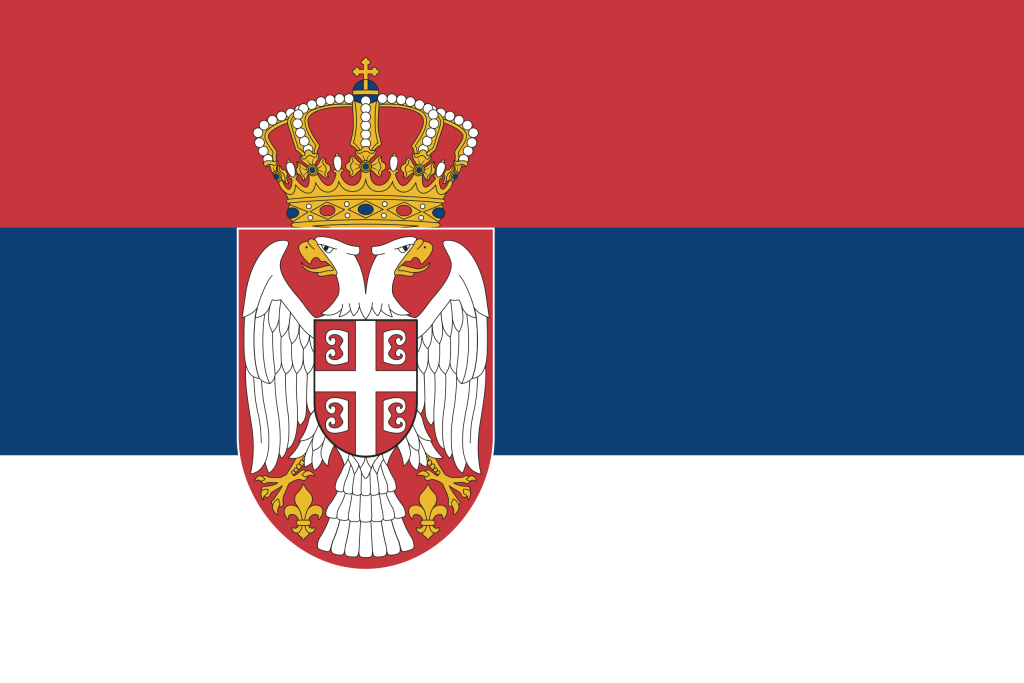
The flag of Serbia is a proud symbol of the nation’s history, sovereignty, and Slavic heritage. Featuring three horizontal stripes of red, blue, and white, with the Serbian coat of arms positioned near the hoist, it reflects the country’s royal traditions, Christian heritage, and national identity. The current design was officially adopted on 11 November 2010, although the tricolour itself has been used by Serbia since the 19th century.
History of the Flag of Serbia
The Serbian tricolour was first officially adopted in 1835 during the Principality of Serbia. Its colours were inspired by the Pan-Slavic colours, which became popular among Slavic nations during the 19th century.
Throughout its history, Serbia used different versions of the flag while it formed part of Yugoslavia and later Serbia and Montenegro. Following Montenegro’s independence in 2006, Serbia continued using the red, blue, and white tricolour as its national flag.
The current version, featuring an updated coat of arms, was officially adopted on 11 November 2010.
Meaning of the Flag of Serbia
Each colour and symbol has historical significance:
- 🔴 Red represents the blood shed in defence of the nation, courage, and strength.
- 🔵 Blue symbolises freedom, loyalty, and the Serbian sky.
- ⚪ White stands for peace, purity, and hope.
- 🛡️ Coat of arms features:
- 🦅 A white double-headed eagle, symbolising the Serbian state and its Byzantine heritage.
- ✝️ A red shield bearing a white cross with four firesteels (ocila), one of Serbia’s oldest national symbols.
- 👑 A royal crown, reflecting Serbia’s historical monarchy.
Together, the red, blue, and white colours also identify Serbia as part of the family of Pan-Slavic nations.
Interesting Facts
- 🇷🇸 Serbia’s tricolour dates back to 1835, making it one of the oldest Pan-Slavic flags.
- 👑 The official state flag includes the coat of arms, while a simpler version without the coat of arms is commonly used as the civil flag.
- 🦅 The double-headed eagle has been associated with Serbia since the medieval Nemanjić dynasty.
- ✝️ The four firesteels (ocila) surrounding the cross are often linked to the traditional Serbian phrase “Only Unity Saves the Serbs.”
- 🌍 Serbia is a landlocked country located in the heart of the Balkans and has played an important role in the region’s history for centuries.
Conclusion
The flag of Serbia is a powerful symbol of the country’s history, faith, and national pride. Its red, blue, and white tricolour reflects Serbia’s Slavic heritage, while the historic coat of arms celebrates centuries of statehood and tradition. Today, it remains one of the most recognisable national flags in Southeast Europe.