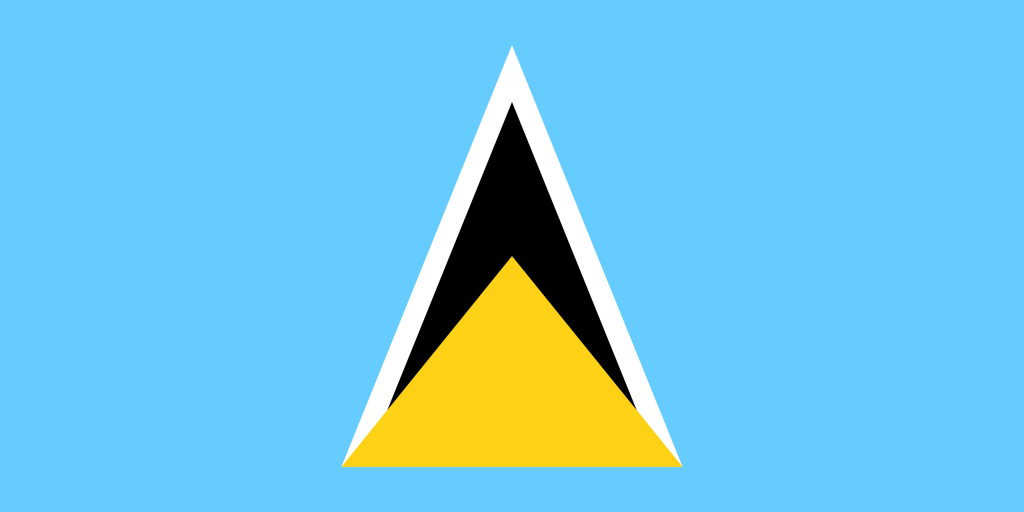
The flag of Saint Lucia is one of the most distinctive national flags in the Caribbean. Featuring a light blue field with a black-and-white isosceles triangle over a yellow triangle, it symbolises the island’s natural beauty, cultural heritage, and aspirations for prosperity. The flag was officially adopted on 1 March 1967 and retained when Saint Lucia gained independence in 1979.
History of the Flag of Saint Lucia
Saint Lucia adopted its national flag on 1 March 1967, when it became an Associated State of the United Kingdom, gaining internal self-government.
The flag was designed by renowned Saint Lucian artist Dunstan St. Omer, who sought to create a modern design reflecting the island’s geography and diverse cultural heritage.
When Saint Lucia became fully independent on 22 February 1979, the flag remained the national symbol. Minor adjustments to the proportions of the triangles were made in 2002, but the overall design has remained unchanged.
Meaning of the Flag of Saint Lucia
Every colour and symbol on the flag has official significance:
- 🔵 Light blue represents the Caribbean Sea, the Atlantic Ocean, and the tropical sky.
- 🟨 Yellow triangle symbolises sunshine, prosperity, and the island’s warm climate.
- ⛰️ Black-and-white triangle represents the iconic Pitons—the volcanic peaks of Gros Piton and Petit Piton, which are a UNESCO World Heritage Site.
- ⚫ Black symbolises the African heritage of the people.
- ⚪ White represents harmony and the peaceful coexistence of the island’s diverse cultures.
Together, the black and white colours signify unity between the different cultural communities of Saint Lucia.
Interesting Facts
- 🇱🇨 Saint Lucia adopted its national flag on 1 March 1967.
- ⛰️ The flag’s triangular design is inspired by the famous Pitons, one of the Caribbean’s most recognisable natural landmarks.
- 🎨 The flag was designed by celebrated artist Dunstan St. Omer.
- 🌋 Gros Piton and Petit Piton are volcanic spires rising dramatically from the Caribbean Sea and are recognised as a UNESCO World Heritage Site.
- 🌴 Saint Lucia is often called the “Helen of the West Indies” because of its beauty and its historical rivalry between Britain and France.
Conclusion
The flag of Saint Lucia is a striking symbol of the island’s spectacular landscapes, cultural diversity, and national pride. Its blue background, golden triangle, and iconic Piton-inspired design make it one of the most unique national flags in the world. Today, it proudly represents one of the Caribbean’s most beautiful and culturally rich island nations.