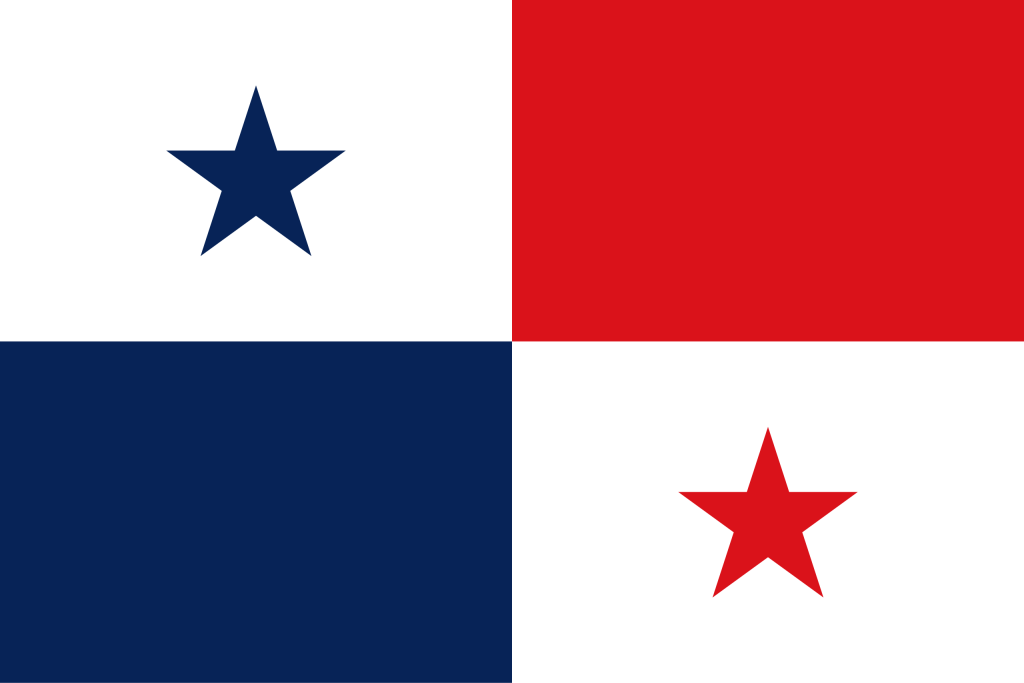
The flag of Panama is a striking symbol of the nation’s independence, democracy, and political unity. Divided into four equal quarters of white, red, and blue, with a blue star and a red star on the white quarters, it represents peace, patriotism, and the country’s two historic political traditions. The flag was officially adopted on 20 December 1903, shortly after Panama gained independence from Colombia.
History of the Flag of Panama
Panama declared its independence from Colombia on 3 November 1903. As the new republic sought a national identity, a flag was designed by Manuel E. Amador, the son of Panama’s first president, Manuel Amador Guerrero.
The original proposal included colours inspired by the United States, but it was rejected in favour of the current design, which reflected Panama’s own political history.
The flag was first raised shortly after independence and was officially adopted on 20 December 1903. Its design was later confirmed by law in 1925.
Meaning of the Flag of Panama
Each colour and symbol on the flag has official significance:
- ⚪ White represents peace and harmony between the nation’s political parties.
- 🔴 Red symbolises authority, patriotism, and the Liberal Party.
- 🔵 Blue represents honesty, purity, and the Conservative Party.
- ⭐ Blue star stands for the purity and honesty of national life.
- ⭐ Red star symbolises authority and the rule of law.
Together, the four quarters represent the balance and cooperation needed to build a united and democratic nation.
Interesting Facts
- 🇵🇦 Panama officially adopted its national flag on 20 December 1903, just weeks after declaring independence.
- ⭐ The two stars do not represent states or provinces but rather the ideals of honesty and authority.
- 🚢 Panama is home to the Panama Canal, one of the world’s most important shipping routes connecting the Atlantic and Pacific Oceans.
- 🌎 Panama is the only country where you can see the sun rise over the Pacific Ocean and set over the Atlantic Ocean from certain locations because of the country’s unique east-west orientation.
- 🏛️ Panama celebrates Flag Day every year on 4 November, the day after Independence Day.
Conclusion
The flag of Panama is a distinctive symbol of peace, democracy, and national unity. Its unique four-quarter design and two stars reflect the country’s political history and commitment to cooperation. Today, it proudly represents one of the Americas’ most strategically important nations and its enduring spirit of independence.