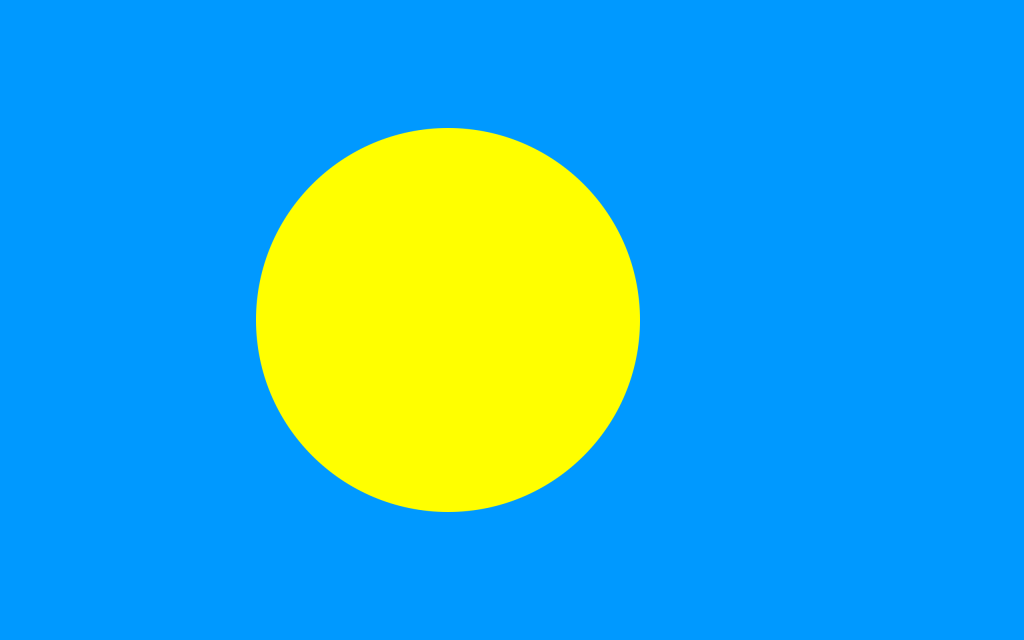
The flag of Palau is one of the most elegant and distinctive national flags in the world. Featuring a light blue field with a golden-yellow disc positioned slightly toward the hoist, it symbolises the Pacific Ocean, peace, and the cultural importance of the full moon. The flag was officially adopted on 1 January 1981, when Palau became a self-governing republic.
History of the Flag of Palau
For much of the 20th century, Palau was administered as part of the Trust Territory of the Pacific Islands, first under Japanese rule before the Second World War and later under United States administration following the war.
As Palau prepared for self-government, a competition was organised to design a new national flag. The winning design, created by Blau Skebong, was officially adopted on 1 January 1981, the day the Republic of Palau came into existence under its new constitution.
On 1 October 1994, Palau became fully independent in free association with the United States. The national flag remained unchanged and continues to represent the country’s sovereignty.
Meaning of the Flag of Palau
Every element of the flag has official and cultural significance:
- 🔵 Light blue represents the Pacific Ocean, the clear sky, peace, and the country’s close relationship with the sea.
- 🌕 Golden-yellow disc symbolises the full moon, which holds great cultural significance in Palau.
- 🌴 The full moon represents peace, harmony, love, tranquillity, and prosperity. Traditionally, it is considered the ideal time for fishing, planting, harvesting, and community celebrations.
- ↩️ The disc is intentionally positioned slightly off-centre toward the hoist to create a balanced appearance when the flag is flying.
Unlike the flags of Japan and Bangladesh, whose discs represent the sun, Palau’s disc represents the full moon.
Interesting Facts
- 🇵🇼 Palau officially adopted its national flag on 1 January 1981.
- 🌕 Palau is one of the very few countries whose national flag features the moon rather than the sun.
- 🎨 The flag was designed by Blau Skebong after a national design competition.
- 🏝️ Palau consists of more than 340 islands, although only a handful are permanently inhabited.
- 🌊 The country is world-famous for its crystal-clear waters, exceptional coral reefs, and the Rock Islands Southern Lagoon, a UNESCO World Heritage Site.
- 🤿 Palau is consistently ranked among the world’s best destinations for scuba diving and marine biodiversity.
Conclusion
The flag of Palau is a beautiful symbol of peace, cultural tradition, and the country’s close connection to the Pacific Ocean. Its simple yet meaningful design, centred around the golden full moon, reflects the values and natural beauty of this island nation. Today, it proudly represents one of Oceania’s youngest independent countries and one of the world’s most pristine marine environments.