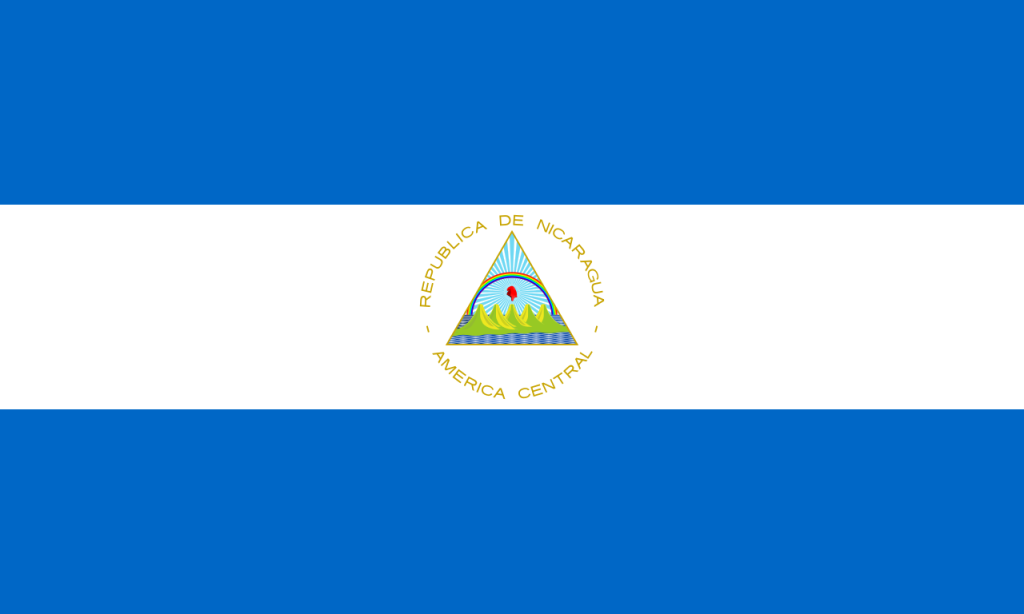
The flag of Nicaragua is a symbol of unity, peace, and the country’s Central American heritage. Featuring three horizontal stripes of blue, white, and blue, with the national coat of arms centred in the white band, it reflects Nicaragua’s geography, independence, and hopes for a prosperous future. The current flag was officially adopted on 27 August 1971, although its design dates back to the 19th century.
History of the Flag of Nicaragua
The blue-and-white colours originate from the Federal Republic of Central America, a federation that existed between 1823 and 1838. After the federation dissolved, Nicaragua retained the traditional colours while introducing its own national emblem.
The modern flag was inspired by the federal flag and was first used in the late 19th and early 20th centuries. The current version, with a standardised coat of arms, was officially adopted on 27 August 1971.
Today, the flag continues to reflect Nicaragua’s historical ties to the other Central American republics.
Meaning of the Flag of Nicaragua
Each colour and symbol on the flag has official significance:
- 🔵 Blue stripes represent the Pacific Ocean and the Caribbean Sea, which border the country.
- ⚪ White stripe symbolises peace, purity, and integrity.
- 🔺 Coat of arms features:
- ⛰️ Five volcanoes, representing the five original member states of the Federal Republic of Central America.
- 🌈 A rainbow, symbolising peace and hope.
- 🗽 A Phrygian cap, representing liberty.
- ☀️ Rays of the rising sun, symbolising a bright future.
- 🔵 The inscription “República de Nicaragua – América Central”, highlighting the country’s Central American identity.
Interesting Facts
- 🇳🇮 Nicaragua officially adopted its current national flag on 27 August 1971.
- 🌈 Nicaragua is one of only two national flags in the world to feature a rainbow, the other being the flag of Bolivia‘s coat of arms. (The rainbow also appears in some national emblems, but very rarely on flags.)
- 🌋 The five volcanoes on the coat of arms represent the historic unity of the Central American republics.
- 🌊 Nicaragua is the largest country in Central America by land area.
- 🏞️ The country is home to Lake Nicaragua, the largest lake in Central America and one of the few freshwater lakes in the world inhabited by sharks.
Conclusion
The flag of Nicaragua is a proud symbol of peace, liberty, and Central American unity. Its blue-and-white colours honour the country’s geography, while the detailed coat of arms celebrates its history and hopes for the future. Today, it remains one of the most distinctive and symbolically rich national flags in the Americas.