The Boeing 767-200 (ICAO: B762) was the first member of the Boeing 767 family and laid the foundation for one of the world’s most successful wide-body aircraft families. Designed as a fuel-efficient twin-engine airliner, it combined the comfort of a wide-body cabin with lower operating costs than earlier four-engine aircraft. First entering service in 1982, the 767-200 became a popular choice for medium- and long-haul routes and played a key role in the rise of modern twin-engine intercontinental travel.
History
The Boeing 767 programme was launched in the late 1970s to replace ageing aircraft such as the Boeing 707 and Douglas DC-8 while complementing the larger Boeing 747. The 767-200 made its first flight on 26 September 1981 and entered commercial service with United Airlines in 1982.
One of its most significant achievements was pioneering ETOPS (Extended-range Twin-engine Operational Performance Standards) operations. The aircraft proved that twin-engine jets could safely fly long overwater routes, changing airline economics and paving the way for aircraft such as the Boeing 777 and 787.
Design
The 767-200 introduced several advanced technologies for its time, including a two-pilot digital glass cockpit, modern flight management systems, and highly efficient high-bypass turbofan engines. Its wide-body cabin featured a comfortable 2-3-2 seating layout in economy class, meaning every passenger was at most one seat away from an aisle.
The aircraft’s combination of efficiency, passenger comfort, and operational flexibility made it popular with airlines operating both domestic trunk routes and international services.
Specifications
| Specification | Boeing 767-200 |
|---|---|
| Manufacturer | Boeing |
| ICAO Code | B762 |
| First Flight | 26 September 1981 |
| Entry into Service | 1982 |
| Length | 48.51 m |
| Wingspan | 47.57 m |
| Height | 15.85 m |
| Typical Seating | 181–214 passengers |
| Maximum Seating | Up to 255 passengers |
| Range | Up to 7,130 km (3,850 nm) |
| Cruising Speed | Mach 0.80 (approximately 850 km/h) |
| Engines | 2 × General Electric CF6, Pratt & Whitney JT9D/PW4000 or Rolls-Royce RB211 |
| Flight Crew | 2 |
Variants
Boeing 767-200
The original passenger version designed for medium- and long-haul operations.
Boeing 767-200ER
The Extended Range variant offered significantly greater range, allowing airlines to operate transatlantic and other long-haul routes with excellent fuel efficiency.
Boeing 767-200SF
Several passenger aircraft were later converted into dedicated cargo aircraft, extending their operational lives in the freight market.
Operators
The Boeing 767-200 was operated by airlines across North America, Europe, Asia, Africa, and South America. Notable operators included:
- United Airlines
- American Airlines
- Delta Air Lines
- Japan Airlines
- All Nippon Airways
- Ethiopian Airlines
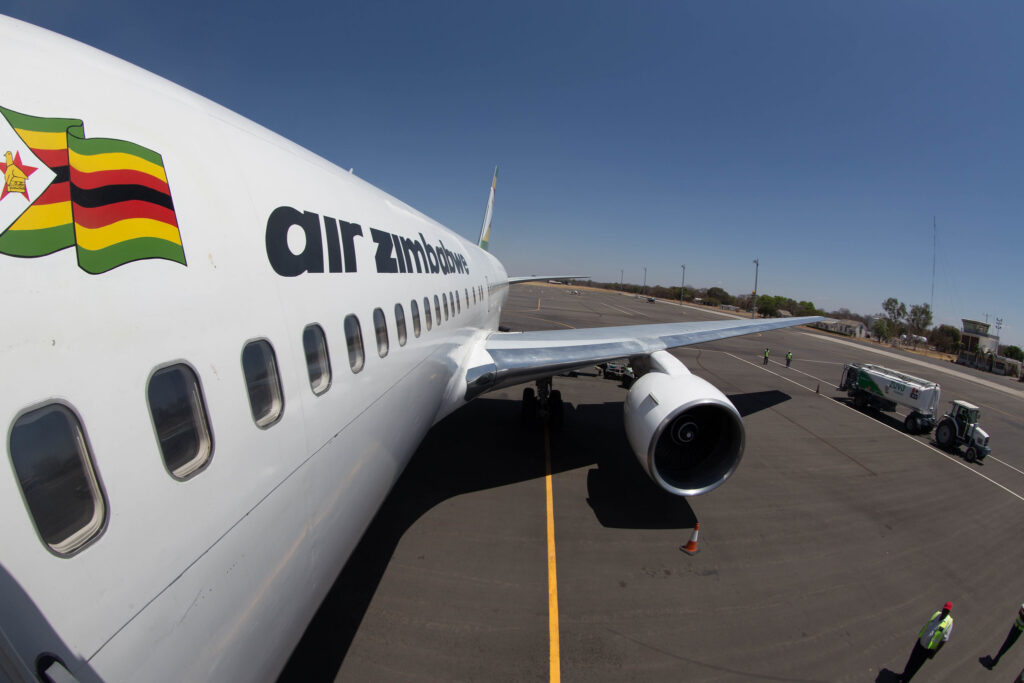
- Air Zimbabwe
- LAN Chile
Today, very few passenger examples remain in service, although converted freighters continue to fly for cargo operators worldwide.
Legacy
The Boeing 767-200 transformed long-haul aviation by proving that twin-engine aircraft could safely and efficiently operate routes once reserved for aircraft with three or four engines. Its success led to the development of the extended 767 variants and influenced every Boeing twin-engine wide-body that followed.
Although newer aircraft have replaced it on most passenger routes, the Boeing 767-200 remains an important milestone in aviation history and a symbol of the transition to the modern era of fuel-efficient long-haul flying.
My Experience
I flew on the Boeing 767-200 with Air Zimbabwe on flight UM322 from Harare (HRE) to Victoria Falls (VFA). The flight covered 346 miles (557 km) and departed at 09:30, arriving at 10:30. I flew on aircraft Z-WPF, sitting in seat 27G.
What made this flight even more special was the aircraft itself. Z-WPF, named Chimanimani after Zimbabwe’s famous mountain range, was delivered to Air Zimbabwe in October 1990. It is one of only two Boeing 767-200ERs ever operated by the airline, making it a rare aircraft to fly on today.
During its long career, Z-WPF has experienced an eventful history. It was temporarily impounded at London Gatwick in 2011 and later at Johannesburg in 2019 because of unpaid debts. The aircraft also spent several periods in storage before returning to service. In 2024 it was briefly leased to Mont Gabaon Airlines before returning to Air Zimbabwe. Today, it remains one of the few active passenger Boeing 767-200s anywhere in the world, making every flight on it a unique experience for aviation enthusiasts.