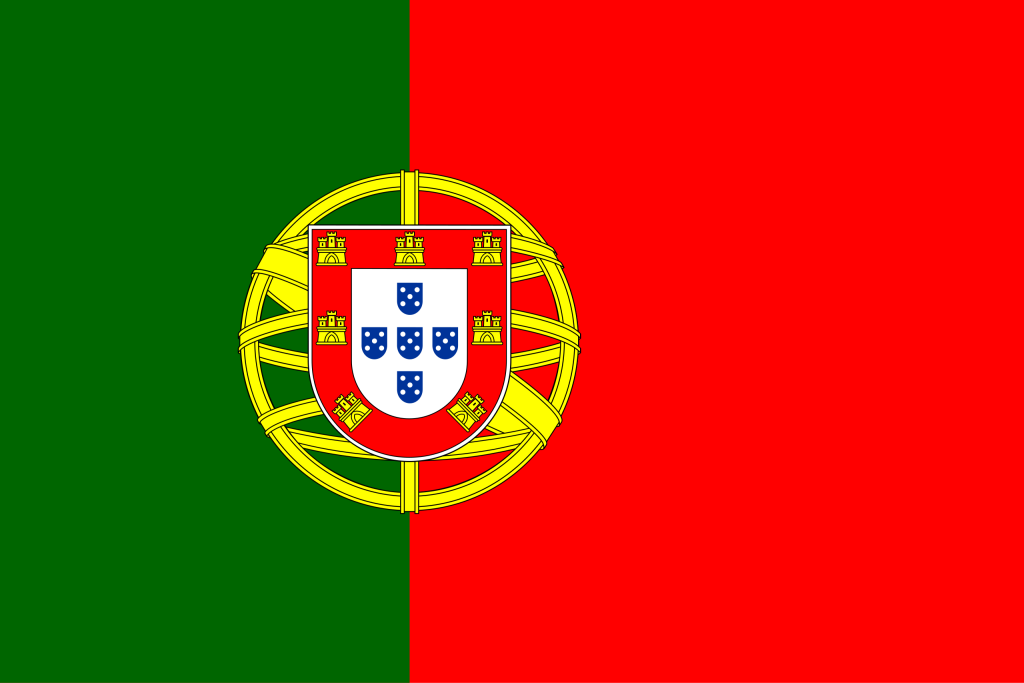
The flag of Portugal is a powerful symbol of the country’s republican identity, maritime history, and centuries of exploration. Featuring a green field at the hoist, a larger red field, and the national coat of arms placed over a golden armillary sphere, it reflects Portugal’s history, sovereignty, and global legacy. The current flag was officially adopted on 30 June 1911, following the establishment of the Portuguese Republic.
History of the Flag of Portugal
Portugal has used many royal banners throughout its long history. Earlier flags were dominated by blue and white, colours associated with the Portuguese monarchy.
Following the Republican Revolution of 5 October 1910, the monarchy was abolished and Portugal became a republic. A special commission was appointed to create a new national flag that would represent the political transformation of the country.
The new green-and-red design was officially approved on 30 June 1911. It replaced the former blue-and-white royal flag and introduced colours closely associated with the republican movement.
Meaning of the Flag of Portugal
Each colour and symbol on the flag carries historical significance:
- 🟢 Green represents hope and was associated with the Portuguese republican movement.
- 🔴 Red symbolises courage, revolution, and the sacrifices made by the Portuguese people.
- 🌐 Golden armillary sphere represents Portugal’s maritime discoveries and its important role during the Age of Exploration.
- 🛡️ Portuguese shield reflects the country’s history, independence, and royal heritage.
- 🔵 Five blue shields are traditionally linked to the five Moorish kings defeated by Afonso Henriques, Portugal’s first king.
- ⚪ Five white dots inside each blue shield are traditionally associated with the wounds of Christ.
- 🏰 Seven golden castles represent fortified places connected with Portugal’s medieval expansion and defence.
The national coat of arms is placed where the green and red sections meet, visually connecting Portugal’s historic monarchy with its modern republic.
Interesting Facts
- 🇵🇹 Portugal adopted its current national flag on 30 June 1911.
- 🌐 The armillary sphere was an important navigational instrument used by Portuguese explorers.
- ⛵ Portugal played a leading role in the Age of Exploration, with navigators such as Vasco da Gama, Bartolomeu Dias, and Ferdinand Magellan.
- 🛡️ The five blue shields have appeared in Portuguese heraldry for centuries.
- 🎉 Portugal celebrates its national day, Portugal Day, on 10 June.
Conclusion
The flag of Portugal is a vivid symbol of revolution, national identity, and maritime achievement. Its green and red fields represent the modern republic, while the armillary sphere and historic shield honour Portugal’s long history and its influence across the world. Today, it remains one of Europe’s most recognisable and symbolically rich national flags.