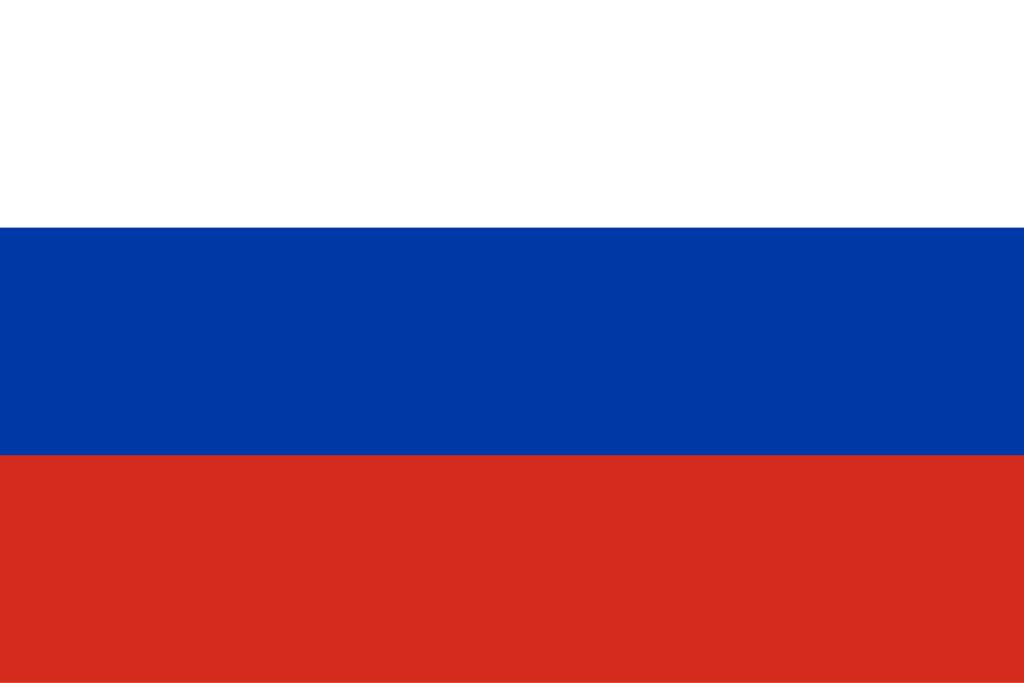
The flag of Russia is one of the world’s most recognisable national flags. Featuring three horizontal stripes of white, blue, and red, it symbolises the country’s history, sovereignty, and Slavic heritage. The current flag was officially restored on 11 December 1993, following the dissolution of the Soviet Union, although its origins date back to the 17th century.
History of the Flag of Russia
The origins of the Russian tricolour date to the reign of Tsar Peter the Great, who was inspired by Dutch ship flags while developing the Russian navy in the late 17th century. The white, blue, and red tricolour gradually became associated with the Russian state and was officially recognised as the national flag of the Russian Empire in 1896.
Following the Russian Revolution of 1917, the tricolour was replaced by the red flag of the Soviet Union, which featured the hammer and sickle.
After the collapse of the Soviet Union in 1991, the historic tricolour was restored. The current design was formally adopted on 11 December 1993 and remains the national flag of the Russian Federation today.
Meaning of the Flag of Russia
The Russian Constitution does not assign an official meaning to the colours of the flag. However, the most widely accepted interpretations are:
- ⚪ White represents peace, honesty, and purity.
- 🔵 Blue symbolises faith, loyalty, and justice.
- 🔴 Red stands for courage, strength, and the sacrifices made throughout Russian history.
The white, blue, and red tricolour also became the inspiration for the Pan-Slavic colours, which appear on the flags of many Slavic nations.
Interesting Facts
- 🇷🇺 Russia’s modern flag was officially restored on 11 December 1993.
- ⚓ The tricolour originated during the reign of Peter the Great, who introduced it for Russian merchant ships.
- 🌍 The Russian flag inspired the Pan-Slavic colours, now found on the flags of countries such as Serbia, Slovakia, Slovenia, and Croatia.
- 🚩 Between 1917 and 1991, Russia used the Soviet flag instead of the white-blue-red tricolour.
- 🗺️ Russia is the largest country in the world, spanning 11 time zones across Europe and Asia.
Conclusion
The flag of Russia is a historic symbol of the nation’s sovereignty and cultural heritage. Its white, blue, and red tricolour has endured for centuries, surviving imperial rule, the Soviet era, and the modern Russian Federation. Today, it remains one of the world’s most recognisable national flags and a lasting emblem of Russia’s history and identity.