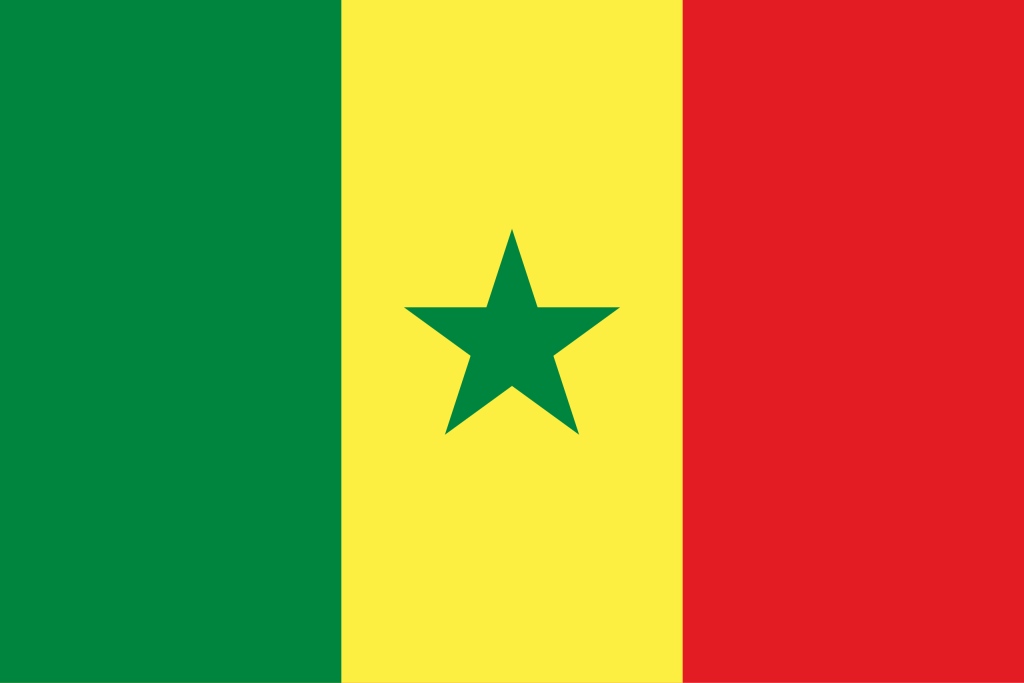
The flag of Senegal is a vibrant symbol of the nation’s independence, unity, and aspirations for progress. Featuring three vertical stripes of green, yellow, and red, with a green five-pointed star in the centre of the yellow stripe, it reflects Senegal’s African heritage, cultural diversity, and hopes for a prosperous future. The flag was officially adopted on 20 August 1960, shortly after Senegal gained independence from France.
History of the Flag of Senegal
Senegal gained independence from France in 1960 as part of the short-lived Mali Federation, which united Senegal and French Sudan (present-day Mali). When the federation dissolved later that year, Senegal became an independent republic.
On 20 August 1960, Senegal adopted its current national flag. The design retained the Pan-African colours of green, yellow, and red while adding a green star to distinguish it from the flag of Mali.
Since independence, the flag has remained unchanged and has become one of West Africa’s most recognisable national symbols.
Meaning of the Flag of Senegal
Each colour and symbol on the flag has official significance:
- 🟢 Green represents hope, prosperity, and, for many Senegalese, Islam—the country’s largest religion. It is also associated with fertility and renewal.
- 🟡 Yellow symbolises wealth, progress, and the nation’s cultural and economic development.
- 🔴 Red stands for sacrifice, determination, and the struggle for independence.
- ⭐ Green five-pointed star represents unity, openness to the world, and hope for the future.
The green, yellow, and red colours are also the traditional Pan-African colours, symbolising solidarity among African nations.
Interesting Facts
- 🇸🇳 Senegal adopted its national flag on 20 August 1960, shortly after becoming fully independent.
- 🌍 The flag uses the Pan-African colours, which are shared by several African countries, including Cameroon, Ethiopia, and Ghana.
- ⭐ The green star distinguishes Senegal’s flag from the neighbouring flag of Mali, which has the same three vertical colours but no central emblem.
- 🎶 Senegal’s national motto is “Un Peuple, Un But, Une Foi” (“One People, One Goal, One Faith”).
- 🏝️ Senegal is home to Gorée Island, a UNESCO World Heritage Site known for its historical significance in the transatlantic slave trade.
Conclusion
The flag of Senegal is a powerful symbol of national unity, independence, and hope. Its green, yellow, and red stripes celebrate the country’s African identity, while the central green star reflects a shared vision for peace, progress, and prosperity. Today, it proudly represents one of West Africa’s most stable and culturally rich nations.