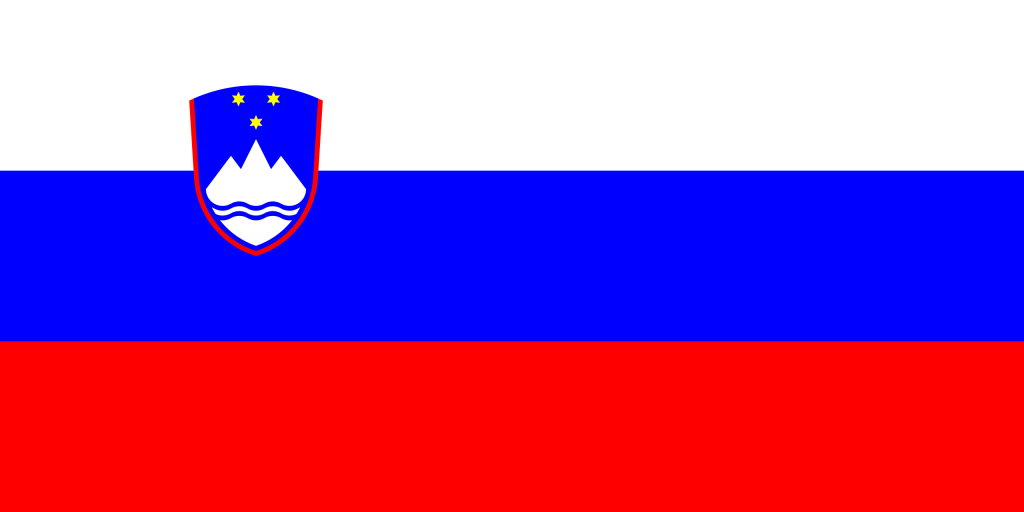
The flag of Slovenia is a symbol of the country’s independence, natural beauty, and Slavic heritage. Featuring three horizontal stripes of white, blue, and red, with the Slovenian coat of arms in the upper hoist corner, it reflects the nation’s history, geography, and aspirations. The current design was officially adopted on 25 June 1991, the day Slovenia declared its independence from Yugoslavia.
History of the Flag of Slovenia
The white, blue, and red tricolour has been associated with Slovenia since 1848, when it was first raised during the Spring of Nations, a period of national movements across Europe. The colours were inspired by the historic coat of arms of the Duchy of Carniola and are also part of the traditional Pan-Slavic colours.
While Slovenia was part of Yugoslavia, the tricolour remained in use with the addition of a red star. Following the country’s declaration of independence on 25 June 1991, the red star was removed and replaced with the current national coat of arms, creating the flag used today.
Meaning of the Flag of Slovenia
Each colour and symbol on the flag carries meaning:
- ⚪ White represents peace, honesty, and the snow-covered Alpine peaks.
- 🔵 Blue symbolises Slovenia’s rivers, lakes, and the Adriatic Sea.
- 🔴 Red represents courage, resilience, and the nation’s struggle for independence.
- 🛡️ Coat of arms features:
- ⛰️ Mount Triglav, Slovenia’s highest mountain and a national symbol.
- 🌊 Two blue wavy lines, representing the Adriatic Sea and the country’s rivers.
- ⭐⭐⭐ Three six-pointed golden stars, taken from the historic coat of arms of the Counts of Celje, one of medieval Slovenia’s most influential noble families.
Interesting Facts
- 🇸🇮 Slovenia adopted its current national flag on 25 June 1991, the day it declared independence.
- ⛰️ Mount Triglav, shown on the coat of arms, is the highest mountain in Slovenia at 2,864 metres (9,396 feet).
- ⭐ The three golden stars originate from the medieval Counts of Celje and are among the country’s oldest national symbols.
- 🌍 Slovenia shares the white, blue, and red Pan-Slavic colours with several other Slavic nations but is distinguished by its unique coat of arms.
- 🏞️ Despite its relatively small size, Slovenia is known for its remarkable natural diversity, ranging from the Julian Alps to the Adriatic coast.
Conclusion
The flag of Slovenia is a proud symbol of the country’s history, independence, and breathtaking landscapes. Its white, blue, and red tricolour reflects Slovenia’s Slavic heritage, while the coat of arms celebrates its mountains, waters, and centuries-old traditions. Today, it stands as a lasting emblem of one of Central Europe’s most scenic and dynamic nations.