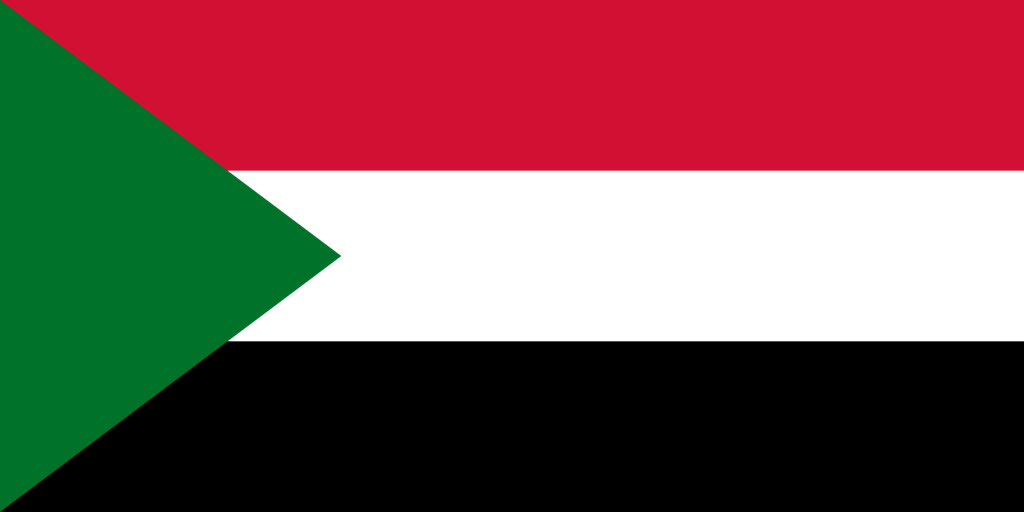
The flag of Sudan is a bold representation of the country’s Arab and African heritage. Featuring three horizontal stripes of red, white, and black with a green triangle at the hoist, it incorporates the Pan-Arab colours, symbolising unity, history, and national identity. The current flag was officially adopted on 20 May 1970.
History of the Flag of Sudan
Sudan gained independence from Anglo-Egyptian rule on 1 January 1956. The country’s first national flag consisted of horizontal blue, yellow, and green stripes, representing the Nile River, the desert, and agriculture.
Following the rise of President Jaafar Nimeiry and a shift toward Pan-Arabism, Sudan adopted its current flag on 20 May 1970. The new design replaced the original tricolour with the Pan-Arab colours, aligning Sudan’s national symbolism with several other Arab states.
Despite political changes over the decades, including the secession of South Sudan in 2011, the flag has remained unchanged.
Meaning of the Flag of Sudan
Each colour of the Sudanese flag has a special meaning:
- 🔴 Red represents the sacrifices made in the struggle for independence and national unity.
- ⚪ White symbolises peace, optimism, and the aspirations of the Sudanese people.
- ⚫ Black represents Sudan itself—the country’s name is derived from the Arabic expression Bilād al-Sūdān, meaning “Land of the Blacks.”
- 🟢 Green triangle symbolises Islam, agriculture, prosperity, and the country’s fertile land.
Together, these four colours form the traditional Pan-Arab colours, which appear in the flags of many Arab nations.
Interesting Facts
- 🇸🇩 Sudan adopted its current flag on 20 May 1970, replacing the blue-yellow-green tricolour used after independence.
- 🌍 The Pan-Arab colours—red, white, black, and green—represent different historical Arab dynasties and the broader idea of Arab unity.
- 🌊 Sudan’s original post-independence flag symbolised the Nile River, the Sahara Desert, and the country’s agricultural lands.
- 🗺️ The country’s name comes from the Arabic Bilād al-Sūdān, meaning “Land of the Blacks.”
- 🇸🇸 When South Sudan became independent in 2011, Sudan retained its existing national flag.
Conclusion
The flag of Sudan is a powerful symbol of the nation’s history, identity, and aspirations. Its Pan-Arab colours reflect both Sudan’s Arab heritage and its place in the wider region, while the green triangle highlights the importance of faith, agriculture, and prosperity. Today, it remains one of the most recognisable national flags in Northeast Africa.