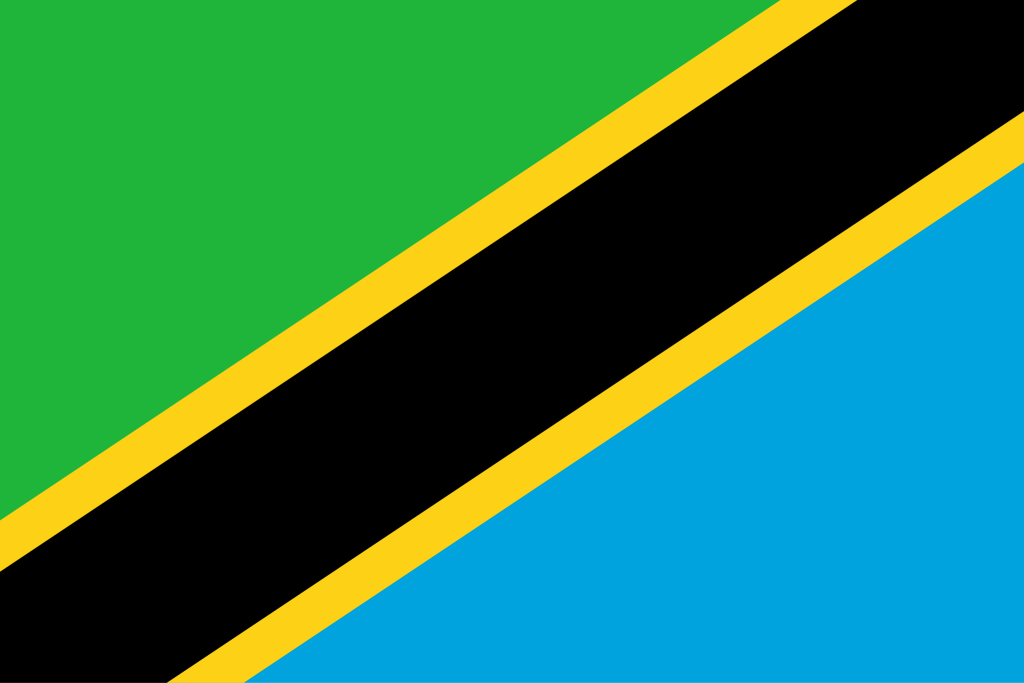
The flag of Tanzania is one of Africa’s most distinctive national flags. Featuring a black diagonal band edged in yellow, dividing a green upper triangle and a blue lower triangle, it symbolises the country’s people, natural resources, and abundant waterways. The flag was officially adopted on 30 June 1964, following the union of Tanganyika and Zanzibar.
History of the Flag of Tanzania
The modern nation of Tanzania was formed on 26 April 1964, when Tanganyika and Zanzibar united to create the United Republic of Tanzania.
To reflect this historic union, a new national flag was introduced on 30 June 1964. Its design combines elements from the former flags of both Tanganyika and Zanzibar, creating a unique symbol of unity while representing the country’s geography and cultural diversity.
Since its adoption, the flag has remained unchanged and is recognised as one of the most iconic flags in Africa.
Meaning of the Flag of Tanzania
Each colour and symbol on the flag has a specific meaning:
- 🟢 Green represents Tanzania’s fertile land, agriculture, and rich vegetation.
- ⚫ Black symbolises the people of Tanzania.
- 🟡 Yellow stands for the country’s abundant mineral wealth and natural resources.
- 🔵 Blue represents the Indian Ocean, lakes, rivers, and the nation’s abundant water resources.
The diagonal arrangement of the colours makes Tanzania’s flag unique among African national flags.
Interesting Facts
- 🇹🇿 Tanzania celebrates Union Day every year on 26 April, commemorating the union of Tanganyika and Zanzibar.
- 🌍 Tanzania is home to Mount Kilimanjaro, Africa’s highest mountain.
- 🦁 The country is renowned for world-famous wildlife destinations such as the Serengeti National Park and the Ngorongoro Conservation Area.
- 🌊 The blue triangle reflects not only the Indian Ocean but also major lakes such as Lake Victoria, Lake Tanganyika, and Lake Nyasa (Lake Malawi).
- 🎨 Tanzania’s diagonal flag design has inspired several other national and regional flag designs around the world.
Conclusion
The flag of Tanzania is a vibrant symbol of unity, diversity, and natural beauty. Its bold diagonal design reflects the country’s historic union, while its colours celebrate the people, fertile landscapes, mineral wealth, and vast waterways that define one of East Africa’s most remarkable nations.