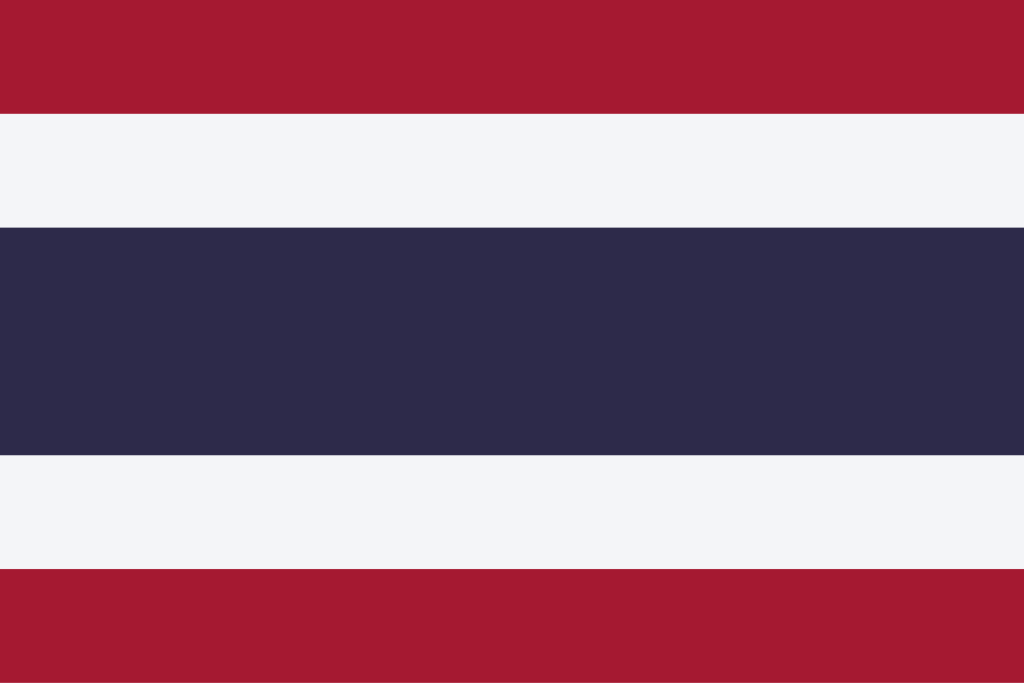
The flag of Thailand, commonly known as the Trairanga (“Tricolour”), is a powerful symbol of the nation’s identity. Featuring five horizontal stripes in red, white, blue, white, and red, it represents the three pillars of Thai society: the nation, religion, and monarchy. The current flag was officially adopted on 28 September 1917 during the reign of King Vajiravudh (Rama VI).
History of the Flag of Thailand
Thailand, formerly known as Siam, has used several national flags throughout its history. Early flags were simple red banners used by the Kingdom of Ayutthaya.
In the 19th century, a white elephant—a royal symbol of Siam—was added to the red flag. During the reign of King Vajiravudh (Rama VI), the design was changed after the king reportedly noticed that a previous flag had been flown upside down following severe flooding.
To create a symmetrical design that could not be displayed incorrectly, the current five-striped flag was introduced in 1917. The central stripe was changed from red to blue, a colour associated with the monarchy and also chosen to honour Thailand’s allies during the First World War.
Meaning of the Flag of Thailand
Each colour of the Thai flag has a special meaning:
- 🔴 Red represents the nation and the sacrifices made by the Thai people.
- ⚪ White symbolises purity and Buddhism, the country’s predominant religion.
- 🔵 Blue represents the monarchy and is the colour traditionally associated with the Thai royal family.
Together, the colours reflect Thailand’s national motto:
“Nation, Religion, King.”
Interesting Facts
- 🇹🇭 The Thai flag is officially known as the Trairanga, meaning “tricolour.”
- 👑 The blue central stripe is twice as wide as the other stripes, emphasising the importance of the monarchy.
- 🐘 Before 1917, Thailand’s national flag prominently featured a white elephant, a long-standing royal symbol.
- 🌏 Thailand is one of the few countries in Southeast Asia that was never formally colonised by a European power.
- 🎉 Thailand celebrates National Flag Day every year on 28 September, commemorating the adoption of the current design.
Conclusion
The flag of Thailand is a timeless representation of the country’s values and traditions. Its distinctive red, white, and blue stripes symbolise the nation, Buddhism, and the monarchy—three pillars that continue to shape Thailand’s identity. As one of Southeast Asia’s most recognisable flags, the Trairanga remains a proud emblem of Thai history, culture, and unity.