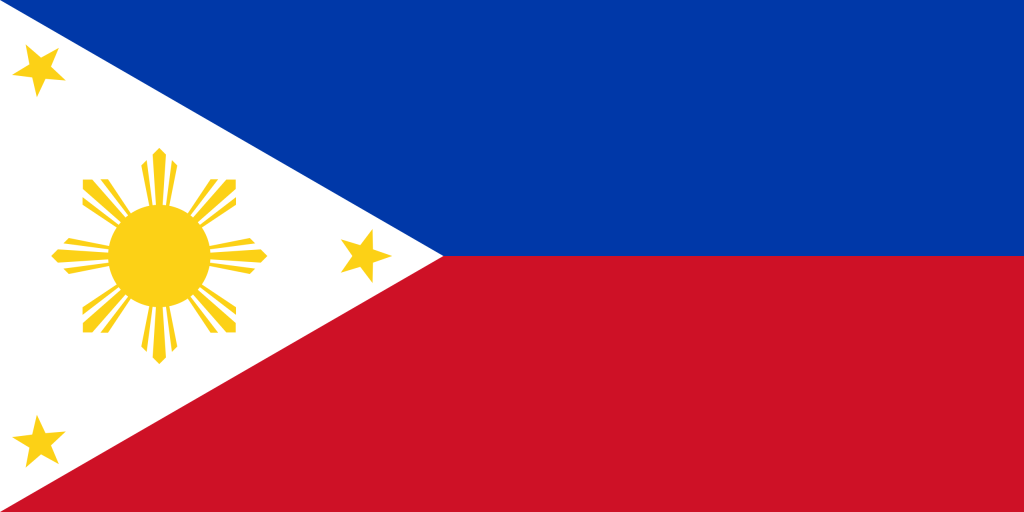
The flag of the Philippines is one of the world’s most distinctive national flags. Featuring two horizontal bands of blue and red, with a white equilateral triangle at the hoist containing a golden sun and three golden stars, it symbolises the country’s independence, unity, and revolutionary history. The current design was officially adopted on 12 February 1998, although the original flag first flew on 28 May 1898.
History of the Flag of the Philippines
The Philippine flag was designed by Emilio Aguinaldo, a leader of the Philippine Revolution against Spanish colonial rule. It was first unfurled after the Battle of Alapan on 28 May 1898 and officially proclaimed during the declaration of Philippine independence on 12 June 1898.
Throughout the American colonial period and the Second World War, the flag’s use was restricted at various times. Following independence from the United States in 1946, the flag once again became the national symbol of the Republic of the Philippines.
The current legal specifications of the flag were established under the Flag and Heraldic Code of the Philippines, signed into law on 12 February 1998.
Meaning of the Flag of the Philippines
Each colour and symbol on the flag has official significance:
- ⚪ White triangle represents equality, liberty, and fraternity.
- 🔵 Blue symbolises peace, truth, and justice.
- 🔴 Red represents patriotism, courage, and the willingness to defend the nation.
- ☀️ Golden sun with eight rays represents freedom and the eight provinces that first revolted against Spanish rule in 1896.
- ⭐⭐⭐ Three golden stars represent the country’s three main geographical island groups:
- 🌴 Luzon
- 🌴 Visayas
- 🌴 Mindanao
Interesting Facts
- 🇵🇭 The Philippines officially adopted its current legal flag specifications on 12 February 1998, although the flag itself dates back to 1898.
- ⚔️ The Philippines is one of the few countries whose national flag changes during wartime. In times of war, the red stripe is displayed above the blue stripe.
- ☀️ The eight rays of the sun honour the first provinces placed under martial law during the Philippine Revolution.
- ⭐ The three stars represent Luzon, Visayas, and Mindanao, the country’s three principal island groups.
- 🌏 The Philippines is an archipelago of more than 7,600 islands, making it one of the world’s largest island nations.
Conclusion
The flag of the Philippines is a powerful symbol of freedom, sacrifice, and national unity. Its unique design, golden sun, and three stars celebrate the country’s revolutionary history and diverse geography. With its rare wartime orientation and rich symbolism, it remains one of the world’s most distinctive and meaningful national flags.