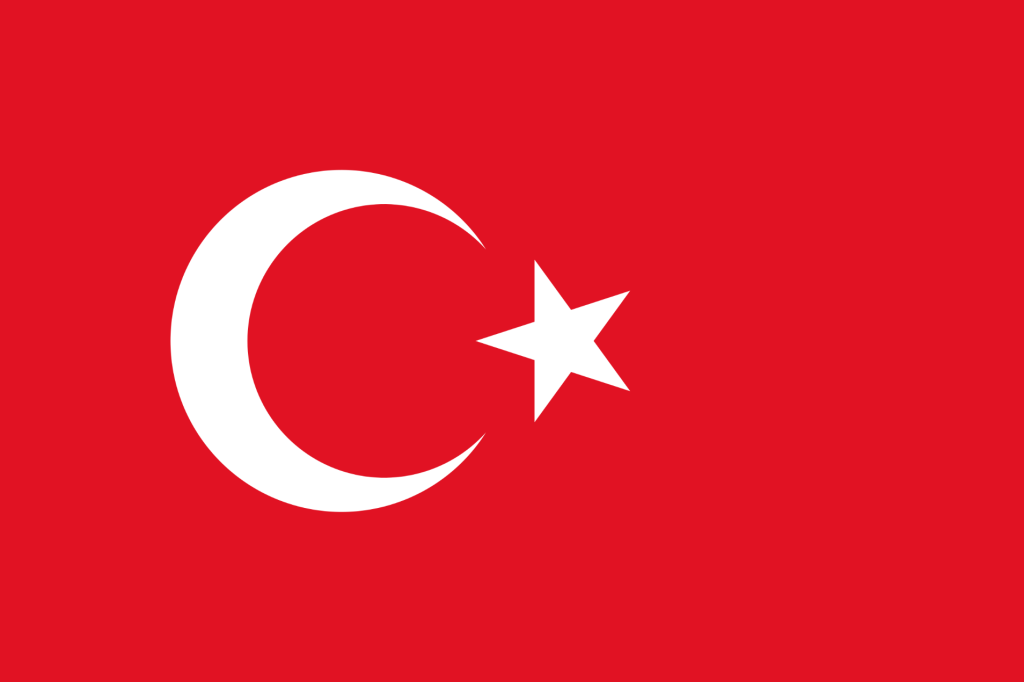
The flag of Turkey, known in Turkish as Türk Bayrağı (“Turkish Flag”) or Al Bayrak (“Red Flag”), is one of the world’s most iconic national flags. Featuring a white crescent and five-pointed star on a red background, it symbolises the country’s history, independence, and cultural heritage. The modern design was officially adopted on 29 May 1936, although its origins date back to the Ottoman Empire.
History of the Flag of Turkey
The red flag has been associated with the Turkish state for centuries, particularly during the Ottoman Empire. Throughout Ottoman history, several versions of the flag were used, often featuring a white crescent on a red field.
In 1844, during the Tanzimat reforms, the Ottoman Empire adopted a flag with a white crescent and five-pointed star, replacing the earlier eight-pointed star. This design became the basis for the modern Turkish flag.
Following the establishment of the Republic of Turkey in 1923, the flag continued to be used. Its exact proportions and specifications were later standardised under the Turkish Flag Law, adopted on 29 May 1936.
Meaning of the Flag of Turkey
Although Turkish law does not officially define the symbolism of the flag, its elements are widely understood to represent the nation’s history and identity:
- 🔴 Red symbolises courage, sacrifice, and the blood shed for the nation’s independence.
- 🌙 White crescent is traditionally associated with Islam and has long been a symbol of the Turkish state.
- ⭐ White five-pointed star represents independence, sovereignty, and the unity of the Turkish nation.
A popular legend tells of the crescent and star being reflected in a pool of blood after a historic battle. While widely known, this story is symbolic rather than historically verified.
Interesting Facts
- 🇹🇷 Turkey celebrates National Sovereignty and Children’s Day on 23 April and Victory Day on 30 August, when the national flag is prominently displayed throughout the country.
- 🌙 The crescent and star have been associated with the Ottoman Empire since at least the 18th century, though similar symbols appeared much earlier in history.
- 📏 The exact dimensions and placement of every element of the flag are precisely defined by Turkish law.
- 🏛️ The Turkish flag has remained virtually unchanged since the founding of the Republic in 1923.
- 🌍 Turkey’s flag has inspired the designs of several other national flags that feature a crescent and star, reflecting historical and cultural connections.
Conclusion
The flag of Turkey is far more than a national emblem. Its bold red field, white crescent, and star reflect centuries of history, the legacy of the Ottoman Empire, and the identity of the modern Turkish Republic. Today, it stands as one of the world’s most recognisable symbols of national pride and independence.