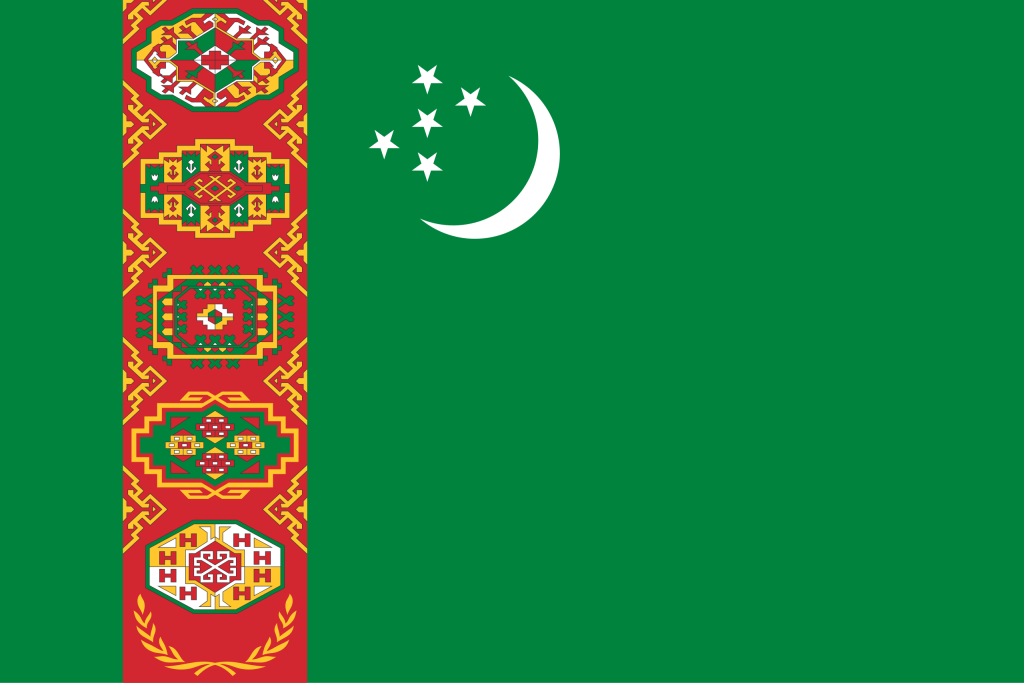
The flag of Turkmenistan is widely regarded as one of the most intricate national flags in the world. Featuring a green field, a red vertical carpet stripe, a white crescent moon, and five stars, it celebrates the country’s rich cultural heritage, independence, and national identity. The current design was officially adopted on 24 January 2001.
History of the Flag of Turkmenistan
Following the dissolution of the Soviet Union, Turkmenistan declared its independence on 27 October 1991. A new national flag was adopted on 19 February 1992, replacing the flag of the Turkmen Soviet Socialist Republic.
The design was later refined, and the current version was officially adopted on 24 January 2001. It retained the country’s traditional carpet motifs while updating the proportions and arrangement of the symbols.
Today, the flag remains one of the country’s most important national symbols and reflects Turkmenistan’s unique cultural traditions.
Meaning of the Flag of Turkmenistan
Every element of the flag has a symbolic meaning:
- 🟢 Green represents Islam, prosperity, and the country’s natural landscape.
- 🌙 White crescent moon symbolises hope, peace, and a bright future.
- ⭐ Five white stars represent the country’s five provinces (Ahal, Balkan, Daşoguz, Lebap, and Mary) and are also associated with the five traditional human virtues.
- 🟥 Red vertical stripe features five traditional carpet guls, each representing one of the major Turkmen tribes:
- Teke
- Yomut
- Arsary
- Chowdur
- Saryk
- 🌿 Below the carpet motifs are olive branches, symbolising Turkmenistan’s commitment to peace and its status as a permanently neutral state, recognised by the United Nations in 1995.
Interesting Facts
- 🇹🇲 Turkmenistan’s flag is often considered the most detailed national flag in the world because of its elaborate carpet designs.
- 🧶 The carpet motifs reflect a centuries-old weaving tradition for which Turkmenistan is internationally renowned.
- 🌍 The country celebrates Flag Day every year on 18 May, which also coincides with Constitution Day.
- 🕊️ The olive branches were added to highlight Turkmenistan’s internationally recognised policy of permanent neutrality.
- 🏛️ The carpet patterns on the flag are also found in the national coat of arms, reinforcing their importance in Turkmen culture.
Conclusion
The flag of Turkmenistan is far more than a national emblem. It combines traditional craftsmanship, tribal heritage, peace, and independence into a single design. With its unique carpet motifs and rich symbolism, it stands out as one of the most distinctive and culturally significant flags in the world.