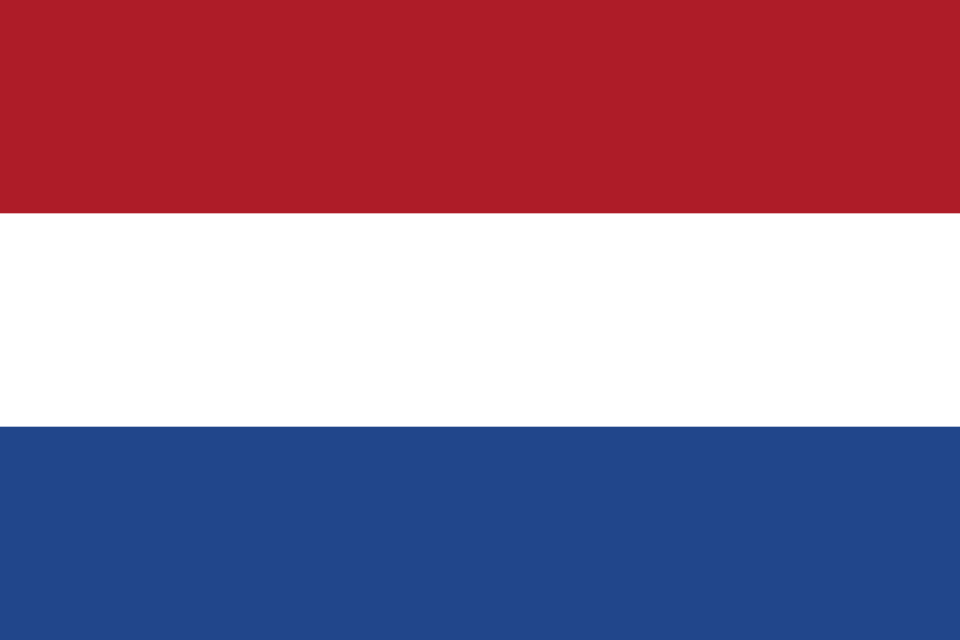
Red, white, and blue, stacked in horizontal bands. Luxembourg‘s flag and the Dutch flag look almost identical, and given how close the two countries sit to each other, it’s easy to assume one borrowed from the other. It didn’t happen that way. The two flags share no documented connection, they just landed on the same three colors independently.
The Dutch flag is the older story by far. It descends from the Prince’s Flag, originally orange, white, and blue, flown during the Dutch Revolt against Spain starting in the late 16th century. Orange gradually gave way to red through the 1600s, likely because red dye held up better at sea, and the switch was eventually made official. Luxembourg’s flag comes from somewhere else entirely, its colors drawn from the 13th-century coat of arms of the House of Luxembourg, which featured a red lion set against blue and white stripes. Those heraldic colors were adapted into a horizontal tricolor around 1830 and formally fixed in 1845.
The two flags are close enough that Luxembourg actually built the difference in on purpose. Its blue is a distinctly lighter sky blue, next to the Netherlands‘ darker cobalt, precisely so the flags wouldn’t be mistaken for one another. Luxembourg’s flag is also slightly longer and narrower than the Dutch one.
None of that has fully settled the matter. The similarity has bothered enough people in Luxembourg over the years that in 2006, a member of parliament formally proposed replacing the tricolor entirely with the Roude Léiw, a red lion banner drawn from the same coat of arms. The proposal didn’t pass, and Luxembourg still flies the tricolor today, distinct blue and all, even if most people at a glance still can’t tell the two apart.