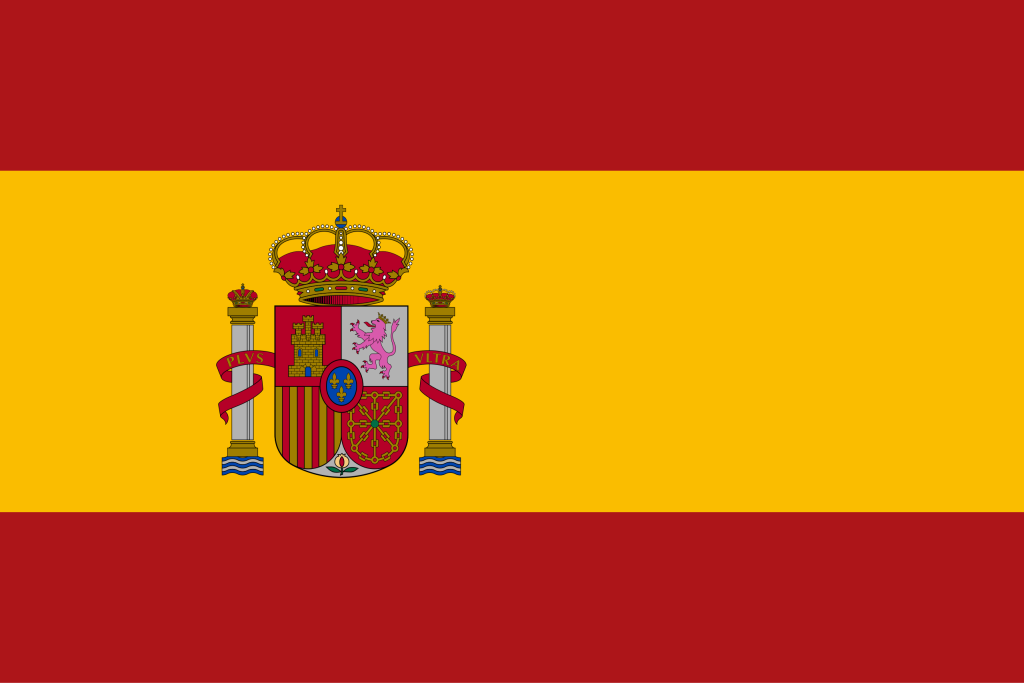
The flag of Spain is one of Europe’s most recognisable national symbols. Featuring three horizontal stripes—red, yellow, and red—with the Spanish coat of arms positioned towards the hoist, it represents the country’s rich history, unity, and monarchy. The current design was officially adopted on 19 December 1981, although the familiar red-and-yellow colours have been associated with Spain since the 18th century.
History of the Flag of Spain
Before the 18th century, Spain used various royal banners rather than a single national flag. In 1785, King Charles III selected a red-and-yellow design for the Spanish Navy because it was easily distinguishable from the predominantly white flags used by other European powers, particularly those of the Bourbon monarchies.
Over time, the naval flag became increasingly associated with Spain as a whole. During the Second Spanish Republic (1931–1939), a different tricolour flag featuring red, yellow, and purple was used. Following the Spanish Civil War, the traditional red-and-yellow design was restored, although the coat of arms changed several times.
The current version of the flag, featuring the modern coat of arms of Spain, was officially adopted on 19 December 1981, following the approval of the new national coat of arms.
Meaning of the Flag of Spain
Each element of the Spanish flag has its own significance:
- 🔴 Red symbolises courage, strength, and the sacrifices made throughout Spain’s history.
- 🟡 Yellow represents generosity, wealth, and the country’s historic prosperity.
- 👑 Coat of arms reflects the unity of Spain and its historic kingdoms:
- 🏰 Castle of Castile
- 🦁 Lion of León
- 🔴🟡 Red-and-yellow stripes of Aragon
- ⛓️ Chains of Navarre
- 🌿 Pomegranate of Granada
- 👑 The central Bourbon-Anjou shield represents the reigning royal dynasty.
- 🏛️ The Pillars of Hercules with the motto “Plus Ultra” (“Further Beyond”) symbolise Spain’s historic role in exploration and its territories beyond Europe.
Interesting Facts
- 🇪🇸 Spain celebrates National Day every year on 12 October, when the national flag is prominently displayed throughout the country.
- ⚓ The red-and-yellow colours were originally chosen for the Spanish Navy because they were highly visible at sea.
- 👑 The current coat of arms has been used since 1981, while the flag’s colours date back to 1785.
- 🌍 Spain’s flag is flown across mainland Spain, the Balearic Islands, the Canary Islands, and the autonomous cities of Ceuta and Melilla.
- 🎨 The nickname “La Rojigualda” (“The Red-and-Yellow One”) is commonly used to refer to the Spanish flag.
Conclusion
The flag of Spain is a proud symbol of the nation’s history, monarchy, and unity. Its bold red and yellow colours have represented Spain for more than two centuries, while the coat of arms reflects the country’s diverse historical kingdoms and enduring national identity. Today, it remains one of the most recognisable flags in the world.