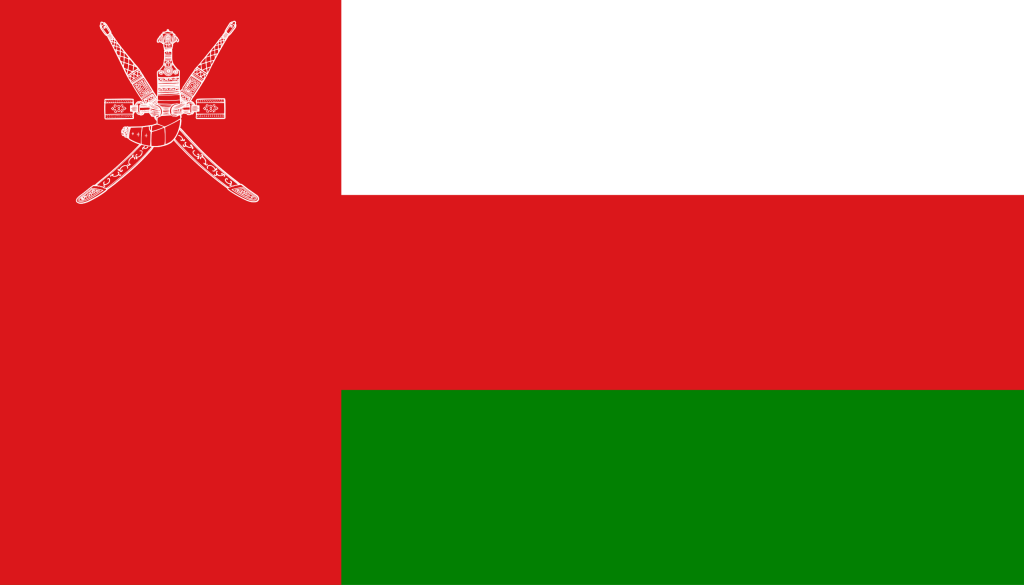
The flag of Oman is a distinctive symbol of the country’s history, independence, and national identity. Featuring three horizontal stripes of white, red, and green, with a vertical red band at the hoist bearing the national emblem, it reflects Oman’s heritage, prosperity, and role as one of the oldest independent states in the Arab world. The current flag was officially adopted on 17 December 2020, following a minor update to standardise its design.
History of the Flag of Oman
For centuries, Oman was represented by a plain red flag, a colour traditionally associated with the ruling Al Said dynasty and many states in the Arabian Peninsula.
In 1970, following the accession of Sultan Qaboos bin Said, Oman introduced a new national flag featuring white, red, and green stripes along with the national emblem. The redesign reflected the country’s modernisation while preserving its historical traditions.
On 17 December 2020, Oman officially standardised the proportions and appearance of the flag without changing its overall design, creating the version used today.
Meaning of the Flag of Oman
Each colour and symbol on the flag has official significance:
- ⚪ White represents peace, prosperity, and the historical Imamate of Oman.
- 🔴 Red symbolises the country’s long struggle against foreign invaders and is also the traditional colour of the Al Said dynasty.
- 🟢 Green represents the fertile mountains and valleys of Oman, particularly the Al Jabal Al Akhdar (Green Mountain), as well as agriculture and prosperity.
- 🗡️ National emblem features a traditional khanjar (curved dagger) crossed with two swords, symbolising Omani heritage, courage, and sovereignty.
The khanjar remains one of Oman’s most recognisable national symbols and is still worn on ceremonial occasions.
Interesting Facts
- 🇴🇲 Oman officially standardised its current flag on 17 December 2020, although the overall design has been in use since 1970.
- 🗡️ The khanjar shown on the flag is part of traditional Omani dress and is recognised as a symbol of national pride.
- 🌍 Oman is one of the oldest independent states in the Arab world, with a history stretching back thousands of years.
- 🏔️ The green stripe is often associated with the fertile Al Jabal Al Akhdar region.
- 🇴🇲 Oman is known for its dramatic mountains, deserts, wadis, and more than 3,000 kilometres (1,864 miles) of coastline along the Arabian Sea and the Gulf of Oman.
Conclusion
The flag of Oman is a proud symbol of the nation’s rich history, cultural heritage, and independence. Its white, red, and green colours, together with the iconic khanjar and crossed swords, reflect Oman’s traditions and its journey into the modern era. Today, it proudly represents one of the Middle East’s most historic and peaceful nations.