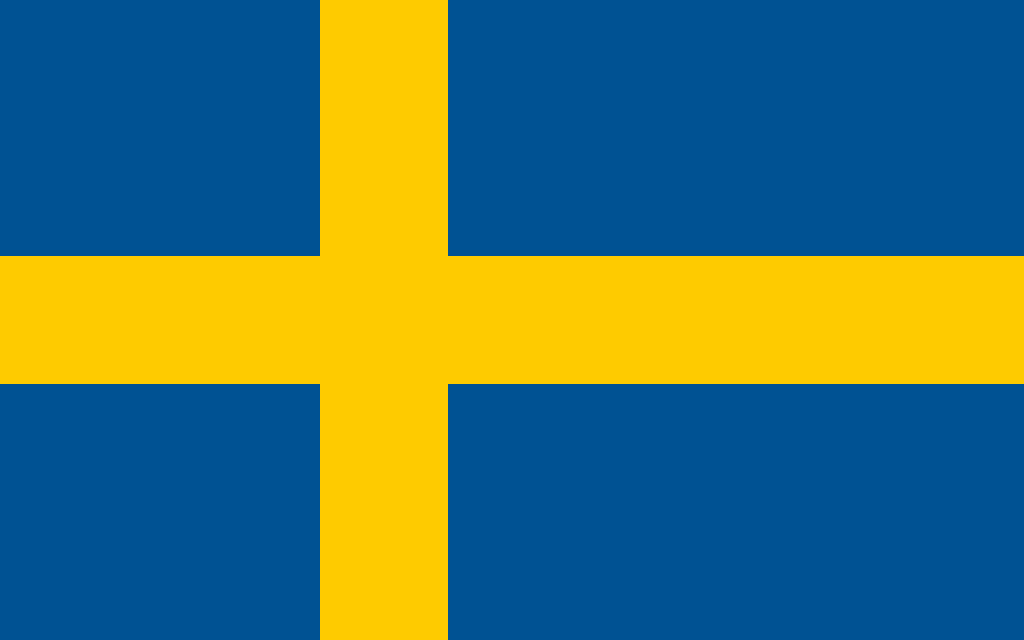
The flag of Sweden is one of the most recognisable Nordic flags. Featuring a yellow Nordic cross on a blue field, it reflects the country’s Christian heritage, royal history, and Scandinavian identity. The current design was officially adopted on 22 June 1906.
History of the Flag of Sweden
The Swedish flag has roots stretching back to the Middle Ages. Its colours are traditionally linked to the Swedish coat of arms, which features a golden yellow cross and crowns on a blue background.
The cross design follows the tradition of the Nordic cross, first associated with Denmark and later used by several other Scandinavian countries. Sweden’s blue-and-yellow flag became increasingly common during the 16th century, especially under King Gustav I Vasa.
After the dissolution of the union between Sweden and Norway in 1905, Sweden adopted a new flag law. On 22 June 1906, the modern Swedish flag was officially established without the earlier union mark.
Meaning of the Flag of Sweden
Every element of the Swedish flag carries symbolic meaning:
- 🔵 Blue represents loyalty, truth, vigilance, and the Swedish sky.
- 🟡 Yellow symbolises generosity, prosperity, and the golden elements of Sweden’s historic coat of arms.
- ✝️ Nordic cross reflects Sweden’s Christian heritage and its place among the Nordic nations.
The off-centred cross is typical of Nordic flags and visually connects Sweden with other Scandinavian countries.
Interesting Facts
- 🇸🇪 Sweden celebrates National Day on 6 June, when the flag is widely displayed across the country.
- 📜 The current flag was officially adopted on 22 June 1906, following the end of the Sweden–Norway union.
- ✝️ The Swedish flag uses the Nordic cross, a design also found in the flags of Denmark, Norway, Finland, Iceland, and the Faroe Islands.
- 👑 The colours blue and yellow come from Sweden’s royal coat of arms.
- 🌍 The Swedish flag is one of the most iconic national symbols in Scandinavia.
Conclusion
The flag of Sweden is simple, elegant, and deeply rooted in history. Its blue field and yellow Nordic cross reflect the country’s royal heritage, Christian traditions, and Nordic identity. Today, it remains a proud symbol of Swedish unity, independence, and national pride.